Athan
Your prayer times. Nobody else's business.
Accurate 5-times prayer reminders and Qibla, computed on your device — no ads, no trackers, no account. Build a gentle salah streak that stays private.
Athan offers an auto-renewing subscription. Payment is charged to your App Store or Google Play account; it renews automatically unless cancelled at least 24 hours before the period ends, and you can manage or cancel anytime in your account settings. Terms and Privacy Policy.
Athan
lifestyle
Your prayer times. Nobody else's business
Account
Not required
Analytics
Opt-in & anonymous
Your data
Stays on device
Ads & trackers
Zero
What you get
Built for exactly this — and nothing you don't need.
Never miss a salah
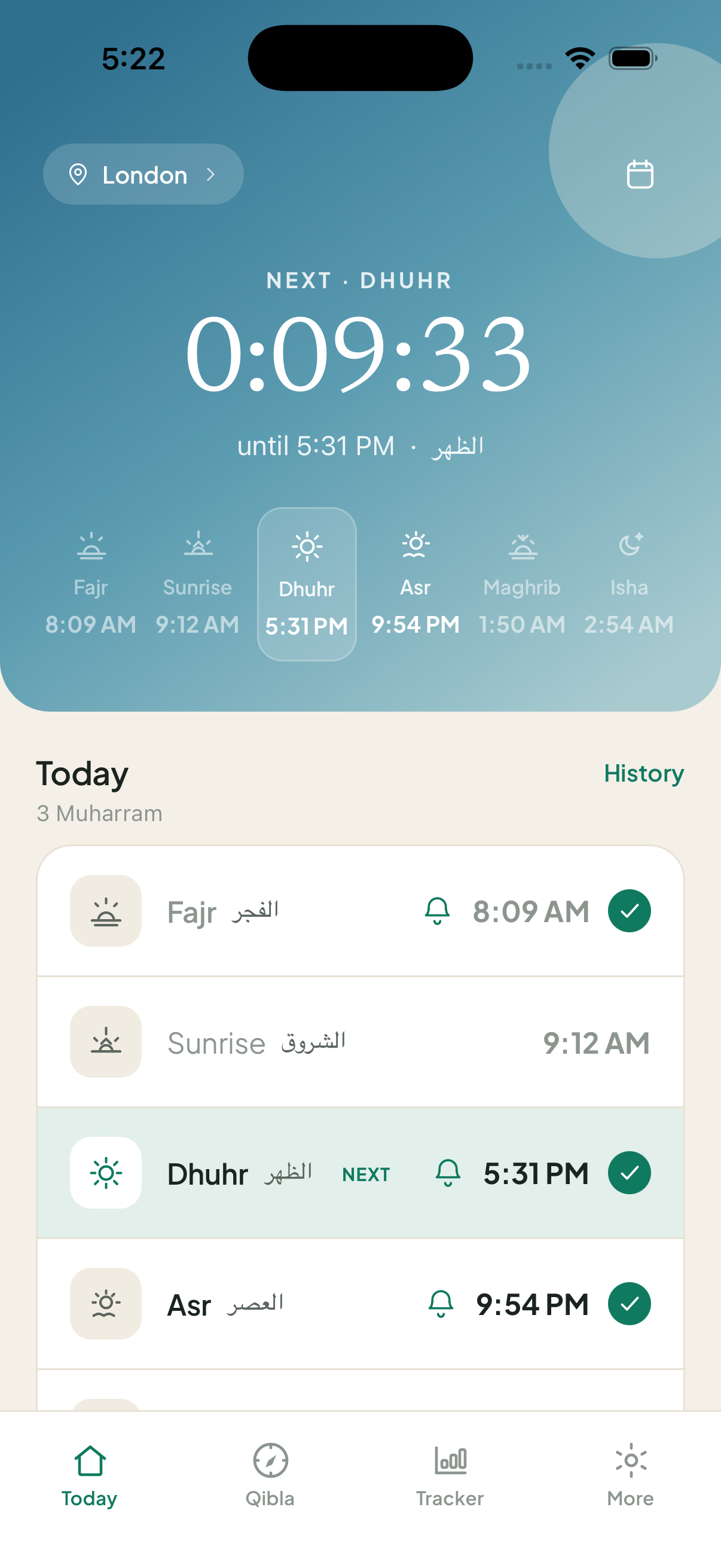
adhan reminders for all five daily prayers, with prayer times computed on-device from your GPS location and the Hijri date: five calculation methods (ISNA, Muslim World League, Umm al-Qura, Egyptian, Karachi) and a Hanafi/Shafi'i setting for Asr so the times match your masjid.
Face the Kaaba in seconds
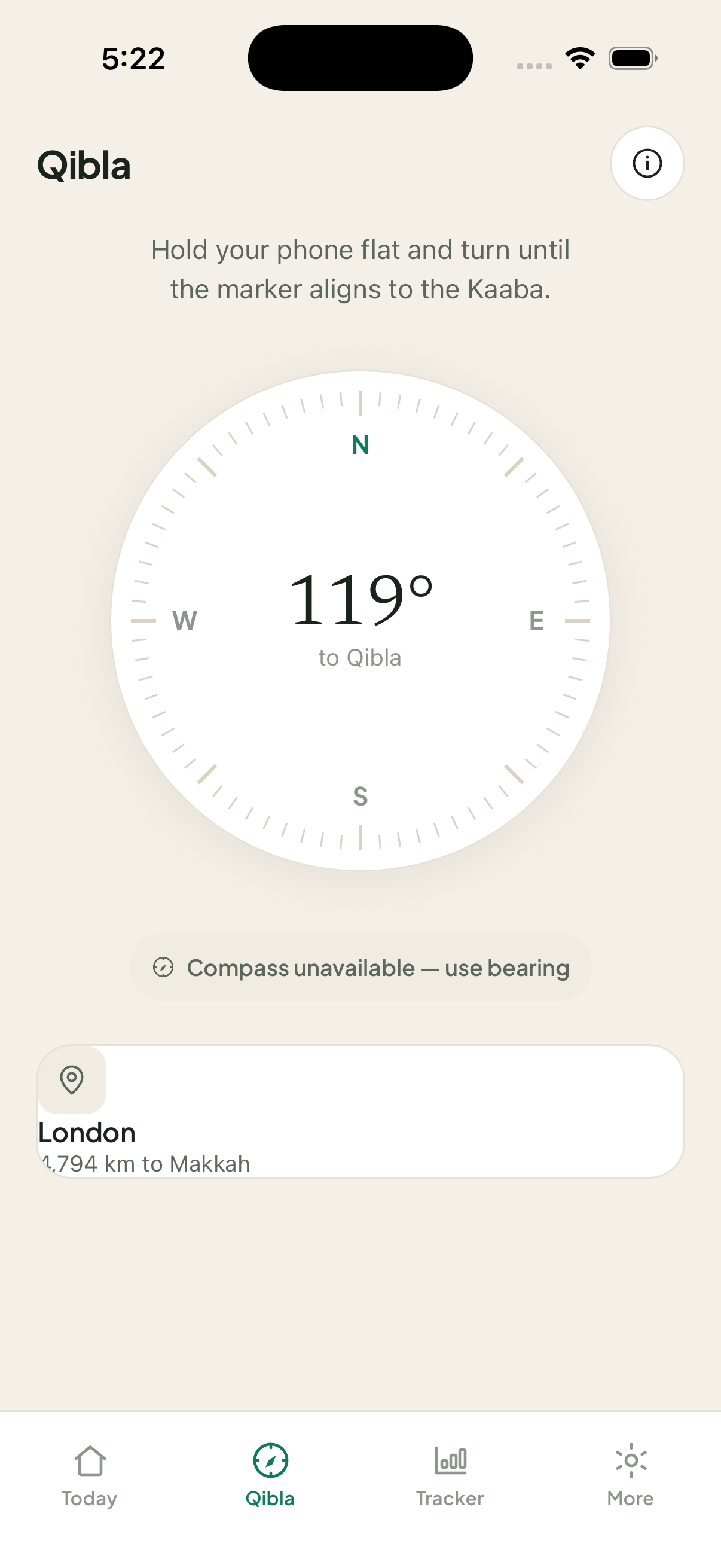
a fast, first-class Qibla compass that reads your phone's magnetometer and location locally, with a subtle haptic when the arrow locks onto Makkah.
Stay consistent without the guilt
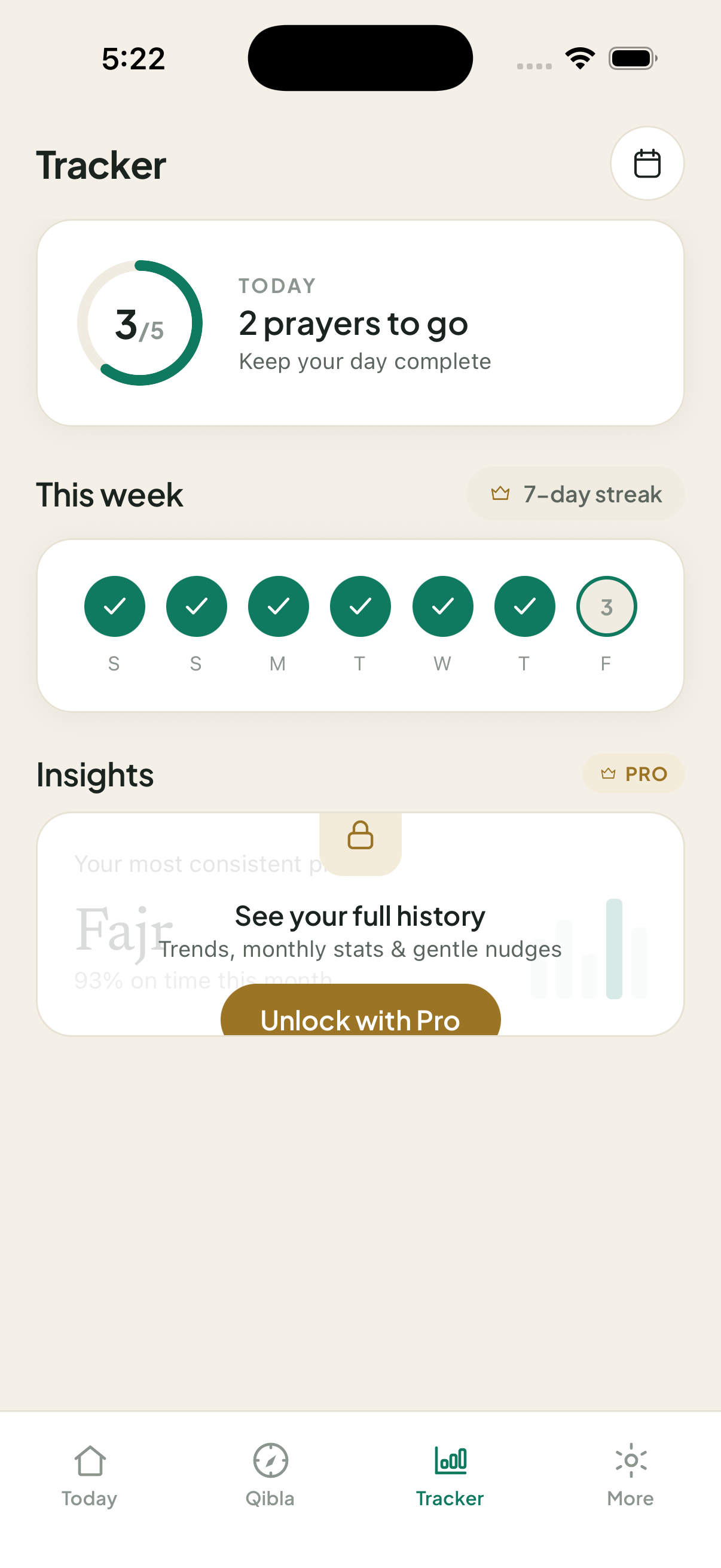
tap to log each prayer and grow a gentle salah streak: and hide the counter entirely if streak pressure ever feels like the wrong kind of pressure.
Quiet, beautiful dhikr in one place
a tasbih counter, a duas collection, and the 99 Divine Names of Allah, all on-device with no network and no ads: plus a built-in Zakat calculator, free.
Hear the call the way you love it
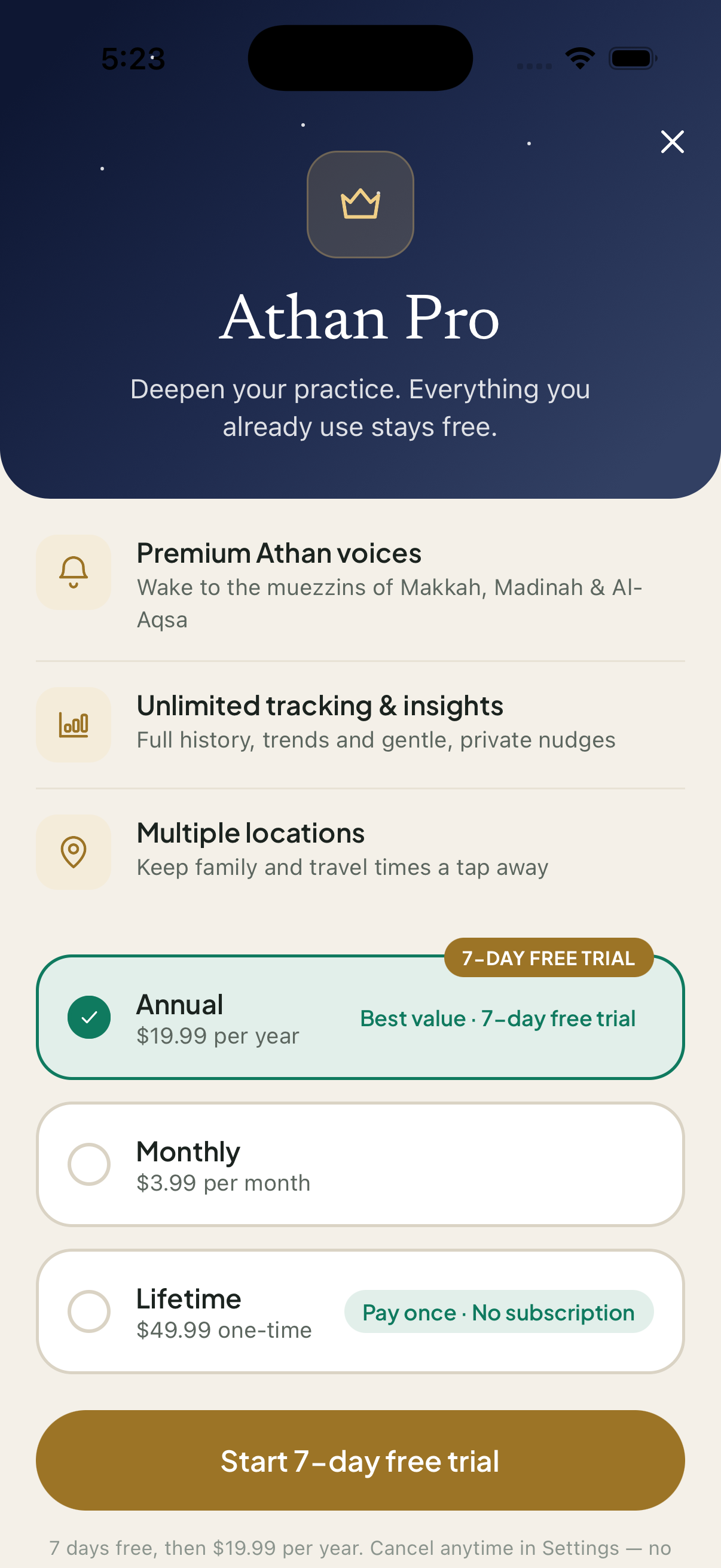
the warm Classic: Cairo adhan voice is free, with twelve premium muezzin reciters from Makkah, Madinah and the Gulf unlocked by Athan Plus.
Pray together, stay accountable
Athan Plus adds private household prayer circles and a qadaa make-up planner so missed prayers have a calm, concrete path back: not a scoreboard.
Everything for the deeper rhythm of the year
Athan Plus brings a prayer journal, monthly report, Ramadan mode, Hijri calendar, a quiet-time focus tool, and a dual companion-city for travel.
Privacy you can actually verify
nothing about your worship leaves your phone. There's no account to create, analytics and crash reporting are opt-in and off by default, and Sign in with Apple is optional: it only syncs your own settings through your own iCloud.
A look inside
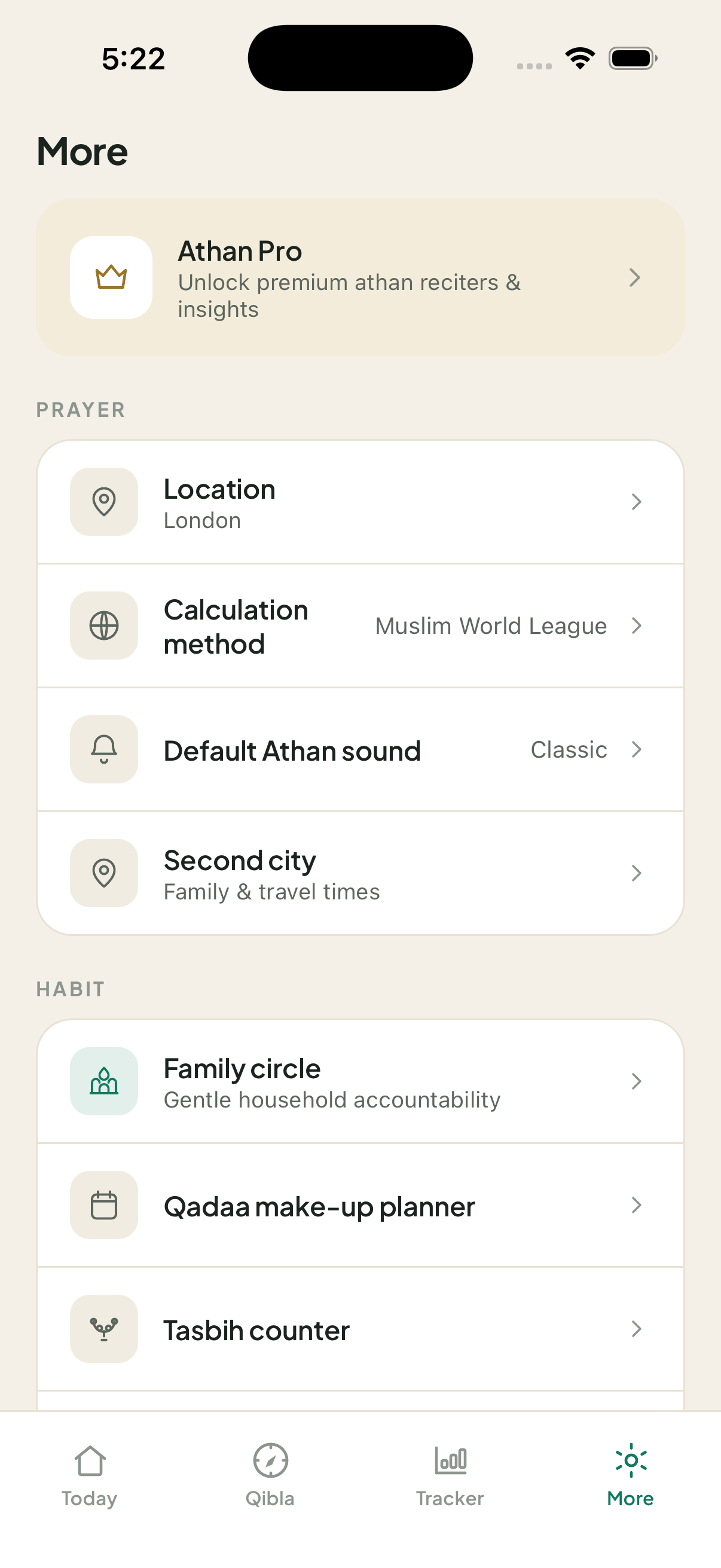
See it in your hands.
How it works
Up and running in under two minutes.
- 01
Set your city and calculation method during a short onboarding. Prayer times and Qibla are computed on-device from your location and are never transmitted.
- 02
Receive an adhan notification before each prayer, then tap to log it and grow your streak.
- 03
Open Athan Plus to unlock family circles, the qadaa make-up planner, premium reciters, journal, Ramadan mode and more — your existing free tools stay free.
- 04
Optionally Sign in with Apple to sync your settings between your own devices via iCloud; Lumen Labs never sees your name or email.
A note from the studio
“Worship is the most personal thing there is, and it always bothered me that the apps we open five times a day were selling ads against our prayer times and shipping our location to who-knows-where. I wanted one that simply tells me when to pray, points me to the Kaaba, and then gets out of the way. So Athan computes everything on your phone and keeps it there — and the only thing that can ever leave is your own settings, into your own iCloud, and only if you ask.”
Questions
The honest answers.
Is Athan free?
Yes — the things you reach for every day are free forever: all five daily prayer times, adhan notifications, the Qibla compass, your salah streak, the tasbih counter, duas, the 99 Divine Names, and the Zakat calculator. Athan Plus is an optional upgrade for premium reciters, prayer circles, the qadaa planner, journal, Ramadan mode and more.
How much does Athan Plus cost?
Athan Plus is $19.99 per year (with a 7-day free trial) or $3.99 per month. Prefer to pay once? There's a $49.99 lifetime option with no subscription. Every plan unlocks the same Plus features.
Do you track me or sell my data?
No. Athan has no ads and no data sale — it's the whole reason it's a paid app. Your location is used on your device to compute prayer times and Qibla and is never sent to a Lumen Labs server. Analytics and crash reporting are opt-in and off until you turn them on.
Does it work offline?
Yes. Prayer times and Qibla are calculated locally using astronomical math, so once your city is set you'll get accurate times and adhan reminders with no internet — perfect for travel, flights, or spotty coverage.
Do I need to create an account?
No account, no email, no sign-up. Athan works fully and anonymously out of the box. Sign in with Apple is entirely optional and only syncs your own settings between your devices through your personal iCloud.
Will the prayer times match my mosque?
They're designed to. You can choose from five calculation methods (ISNA, Muslim World League, Umm al-Qura, Egyptian General Authority, Karachi) and set Hanafi or Shafi'i for Asr, so Fajr through Isha line up with your local masjid.
How is Athan different from other prayer apps?
Most prayer apps are free because you're the product — ads, trackers, location data. Athan flips that: a calm, reverent app that you pay for so it never has to monetize your worship, plus an accountability layer (streak, circles, qadaa planner) built to keep you consistent, not just to look up times.
Is there an Android version?
Athan is built for iPhone and available on the App Store. An Android build is in progress, so keep an eye out if you're on Android.
Everything — prayer logs, streaks, qadaa counts, settings, and family circles — is stored locally on your device in AsyncStorage. Athan is offline-first with no backend.
From the journal
Notes on the practice.
- 01
What to Do When You Make a Mistake in Prayer: The Psychology of Sujud al-Sahw
Made a mistake in prayer and want to start over? Sujud al-sahw is a built-in repair ritual — and psychology says repairing, not restarting, keeps worship alive.
2026-07-13
7 min read
- 02
How to Learn Salah Step by Step: The Science of Learning Prayer as a Skill, Not a Test
How to learn salah step by step, according to the science of skill learning: your body — not your memory — is what learns to pray, and mistakes are part of the design.
2026-07-13
7 min read
- 03
Why You Keep Delaying Isha Prayer: The Science of Bedtime Procrastination
Delaying Isha prayer night after night isn't laziness — psychologists call it bedtime procrastination, and it has a fix that isn't willpower. Here's the science.
2026-07-12
6 min read
- 04
How to Pray Through Grief: The Science of Why Salah Holds You When Loss Unmakes Your Days
How to pray through grief when you can barely stand: what bereavement science says about ritual, and why the five daily prayers hold you when nothing else does.
2026-07-12
6 min read
- 05
Why Friday Feels Like a Fresh Start: The Psychology of Jumu'ah as a Weekly Reset
The Friday fresh start effect is real psychology, not wishful thinking. Here's why Jumu'ah resets your week — and how to make Friday's resolve survive until Thursday.
2026-07-11
6 min read
- 06
How to Pray Istikhara: The Psychology of What Actually Happens When You Pray Over a Decision
How to pray istikhara — and what the psychology of decision-making says actually happens when you name a choice, argue both sides, and sleep on it.
2026-07-11
7 min read
- 07
Why You Always Miss Asr Prayer: The Science of the Prayer With No Natural Cue
If you always miss Asr prayer, it's rarely weak faith. Asr is the one prayer with no natural cue — and the memory science explains exactly why it vanishes.
2026-07-10
7 min read
- 08
Unanswered Dua: Why Making the Same Dua Over and Over Still Changes You
An unanswered dua can feel like shouting into a well. The science of repetition, hope, and rumination explains what years of asking are quietly doing to you.
2026-07-10
7 min read
- 09
Making Dua in Your Own Language: The Science of Why Your Mother Tongue Hits Harder
Making dua in your own language can feel uncomfortably real — and research on how the brain processes a second language explains exactly why that discomfort is the point.
2026-07-10
7 min read
- 10
Why Your Phone Ruins Your Prayer Even When It's Face-Down: The Science of Phone Distraction During Prayer
Phone distraction during prayer doesn't need a notification to work. Research on smartphone "brain drain" shows the device drains focus while silent — here's the fix.
2026-07-09
7 min read
- 11
How to Thank Allah in Dua When Life Feels Ordinary: The Science of Noticing What You Already Have
Wondering how to thank Allah in dua when nothing feels remarkable? The problem isn't ingratitude. It's a brain that stops seeing what stays. Here's the fix.
2026-07-09
7 min read
- 12
Why You Should Pray When You Don't Feel Like It: The Science of Motivation Following Action
Praying when you don't feel like it can feel like faking it — but behavioral science says motivation follows action, not the reverse. Here's why showing up first works.
2026-07-08
6 min read
- 13
Why Familiar Prayers Can Start to Feel Empty: The Science of Semantic Satiation
Why prayer feels empty and repetitive isn't a flaw in your faith. It's semantic satiation — a real quirk of the brain — and there's a way through it.
2026-07-08
6 min read
- 14
Why Standing Up Straight in Prayer Changes How You Feel: The Science of Posture and Mood
How posture affects your mood is one of psychology's quiet findings — the way you hold your body feeds back into how you feel. Here's what standing upright in prayer quietly does to the mind.
2026-07-07
6 min read
- 15
Why Making Dua for Other People Quietly Changes You: The Psychology of Praying for Someone Else
Making dua for others isn't only generous — it rewires your own mind. The psychology of praying for someone else, from forgiveness to less rumination and more warmth.
2026-07-07
6 min read
- 16
How to End Your Prayer Well: The Psychology of the Way You Finish
Learning how to end your prayer well matters more than you'd think. The peak-end rule shows why the last moment of salah quietly shapes what you carry into the rest of your day.
2026-07-07
6 min read
- 17
Why Saying Your Prayers Out Loud Works: The Science of Reciting vs. Reading Silently
Praying out loud vs silently isn't just tradition — speaking words aloud builds a richer memory and steadier focus than reading them in your head. Here's the science.
2026-07-06
6 min read
- 18
How to Slow Down During Prayer: The Psychology of Why Rushing Makes It Feel Longer
Ever notice prayer drags exactly when you're in a hurry? Here's how to slow down during prayer — and the strange psychology of why rushing makes it feel longer, not shorter.
2026-07-06
6 min read
- 19
Why You Lose Count of Rakats in Prayer: The Science of Doing Things on Autopilot
Losing count of rakats in prayer isn't carelessness — it's how practiced minds work. What action-slip psychology says, and what actually helps you keep your place.
2026-07-05
7 min read
- 20
How to Wake Up for Tahajjud: What the Science of Segmented Sleep Says About Praying at Night
How to wake up for tahajjud without wrecking your rest: what segmented sleep research reveals about the last third of the night — and why your body may already know the way.
2026-07-05
7 min read
- 21
Why Dhikr After Prayer Calms the Mind: The Science of Counted Repetition
Dhikr after prayer isn't just tradition — counted repetition calms the nervous system and changes how you remember praying. The science of tasbih.
2026-07-04
7 min read
- 22
How to Memorize Quran Surahs That Actually Stick: The Science of Spaced Repetition
How to memorize Quran surahs so they stick: the science of spaced repetition and retrieval practice — and why the five daily prayers are the perfect review schedule.
2026-07-04
6 min read
- 23
Why Praying in the Same Spot Every Day Works: How to Create a Prayer Space at Home
How to create a prayer space at home — and why praying in the same spot each day makes focus easier. The psychology of place, habit cues, and quiet corners.
2026-07-03
7 min read
- 24
How to Pray While Traveling: Why Trips Break the Habit — and How Habit Science Rebuilds It
Learn how to pray while traveling: why trips quietly break prayer habits, what habit science says about disrupted routines, and how to keep salah steady anywhere.
2026-07-03
7 min read
- 25
How to Teach Kids to Pray: The Quiet Science of Watching, Not Telling
How to teach kids to pray without nagging or bribes — what research on imitation, ritual learning, and motivation says about children who grow up and keep praying.
2026-07-02
7 min read
- 26
The Psychology of Sujood: Why Lowering Your Head to the Ground Quiets the Mind
The psychology of sujood explains why placing your forehead on the ground in prayer settles the mind — how posture, humility, and embodied cognition calm a racing head.
2026-06-27
6 min read
- 27
How to Stop Looking Around During Prayer: The Science of Lowering Your Gaze to Focus
Lowering your gaze during prayer isn't just etiquette — it's how attention works. The science of where to look in salah to stop getting distracted and find calm focus.
2026-06-27
7 min read
- 28
Why Waking Up for Fajr Resets Your Body Clock: The Science of Morning Light
Waking up for Fajr is hard partly because of biology — but catching dawn light is one of the strongest signals your body clock receives. Here's the science.
2026-06-26
7 min read
- 29
Why Prayer Times Change Every Day: The Astronomy Behind the Five Daily Prayers
Why do prayer times change every day? The answer is written in the sun's path across the sky. A clear, accurate guide to the astronomy behind the five daily prayers.
2026-06-26
7 min read
- 30
What Making Dua Does for an Anxious Mind: The Psychology of Putting Worry Into Words
Why does making dua for anxiety quiet a racing mind? The science of affect labeling explains what happens when you turn worry into spoken words.
2026-06-26
7 min read
- 31
What Is Niyyah in Prayer — and Why Naming Your Intention First Changes Everything
What is niyyah in prayer? The quiet act of naming your intention before salah recruits attention and breaks autopilot. The behavioral science of starting on purpose.
2026-06-24
7 min read
- 32
Why Praying in Congregation Feels Different: The Science of Moving in Sync
Praying in congregation feels different for a reason. Here's the behavioral science of synchronized movement, collective effervescence, and why standing shoulder to shoulder bonds people.
2026-06-23
6 min read
- 33
How Prayer Calms Your Nervous System: The Quiet Biology of Stillness and Repetition
How prayer calms the nervous system: the real biology of slow breathing, repeated words, and physical stillness that shifts your body out of fight-or-flight.
2026-06-23
7 min read
- 34
How Prayer Breaks Reset Your Focus: The Science of Attention Residue
Attention residue is why your mind stays stuck on the last task. Here's how short prayer breaks reset your focus, and what the science of mental transitions reveals.
2026-06-23
6 min read
- 35
Why the Adhan Feels Calming: The Quiet Science of the Call to Prayer
Why is the adhan calming? The call to prayer works like a learned cue that quiets the mind. Here's the gentle science behind that five-times-a-day shift.
2026-06-22
6 min read
- 36
Structuring Your Day Around Prayer Times: The Quiet Logic of Five Fixed Pauses
Structuring your day around prayer times does more than mark worship — it punctuates the hours, clears mental residue, and gives a scattered day a spine.
2026-06-22
7 min read
- 37
What Wudu Does for Your Mind: The Quiet Power of a Pre-Prayer Ritual
What wudu does for the mind is more than cleanliness — discover how the pre-prayer washing acts as a transition ritual that calms anxiety and resets your attention.
2026-06-21
7 min read
- 38
How to Find the Qibla Direction — and Why It Sometimes Points North
How to find the Qibla direction anywhere, why facing Mecca can mean facing north, and what orienting your body toward one point quietly does to attention.
2026-06-21
7 min read
- 39
How to Pray at Work Without Feeling Awkward or Falling Behind
How to pray at work without the scramble: where to pray, when to fit Dhuhr and Asr, and the small bit of planning that makes praying salah at work feel ordinary.
2026-06-18
6 min read
- 40
Keeping the Prayer Habit After Ramadan
Why prayer consistency fades after Ramadan and how to keep it — using the fresh-start effect, gentle review, and family accountability to protect the gains.
2026-06-11
8 min read
- 41
Prayer Reminders vs. a Prayer Habit: Why Notifications Aren't Enough
A clear-eyed comparison of prayer reminder apps versus building a real salah habit — why notifications fade, and what to look for when choosing a prayer app.
2026-06-08
7 min read
- 42
Finding Focus in Prayer When Your Mind Won't Settle
Why the mind wanders in salah and what actually helps — a grounded look at khushu, attention, and building focus in prayer instead of forcing it.
2026-06-04
8 min read
- 43
Getting Back Into Prayer: A Gentle Primer for Returning
A calm beginner's primer for returning to salah — the five daily prayers and their windows, and a low-pressure way to start praying again without overwhelm.
2026-05-31
8 min read
- 44
Why Praying on Time Is So Hard — Even When You Want To
An honest look at why praying on time is so hard even for sincere people — the intention–action gap, the Fajr problem, and what actually closes it.
2026-05-26
7 min read
- 45
The Quiet Psychology of a Prayer Streak
How a prayer streak actually works on the mind — the science of cues, loss aversion, and why an all-or-nothing streak can quietly undermine a salah habit.
2026-05-20
8 min read
- 46
What People Get Wrong About Making Up Missed Prayers
A calm, non-judgmental look at the myths around making up missed prayers (qadaa) — what the worry usually gets wrong, and a gentler way to begin.
2026-05-14
8 min read
- 47
How to Pray Five Times a Day Without Relying on Willpower
A practical guide to praying five times a day consistently by anchoring each salah to your existing routine instead of waiting to feel motivated.
2026-05-08
7 min read