Sesh
Make the therapy you pay for actually stick.
Hold onto the breakthroughs between therapy sessions. Log how you felt and what came up, watch patterns surface — private, on-device, no account.
Sesh offers an auto-renewing subscription. Payment is charged to your App Store or Google Play account; it renews automatically unless cancelled at least 24 hours before the period ends, and you can manage or cancel anytime in your account settings. Terms and Privacy Policy.
Sesh
wellness
Make the therapy you pay for actually stick
Account
Not required
Analytics
Opt-in & anonymous
Your data
Stays on device
Ads & trackers
Zero
What you get
Built for exactly this — and nothing you don't need.
Stop losing breakthroughs by Wednesday
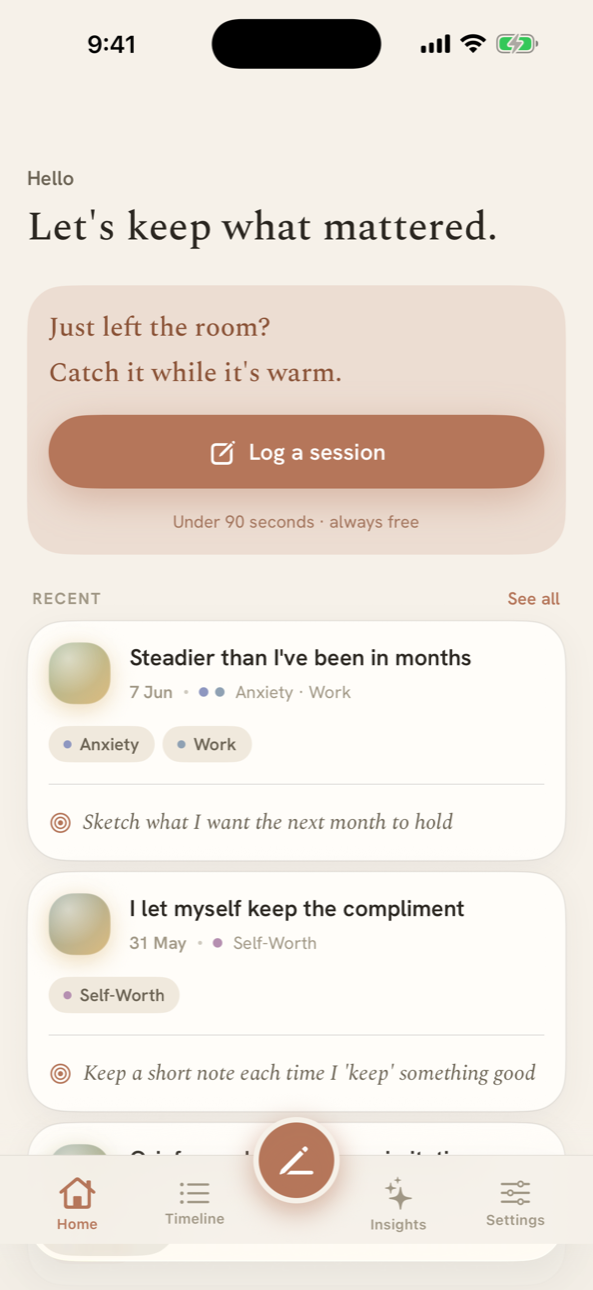
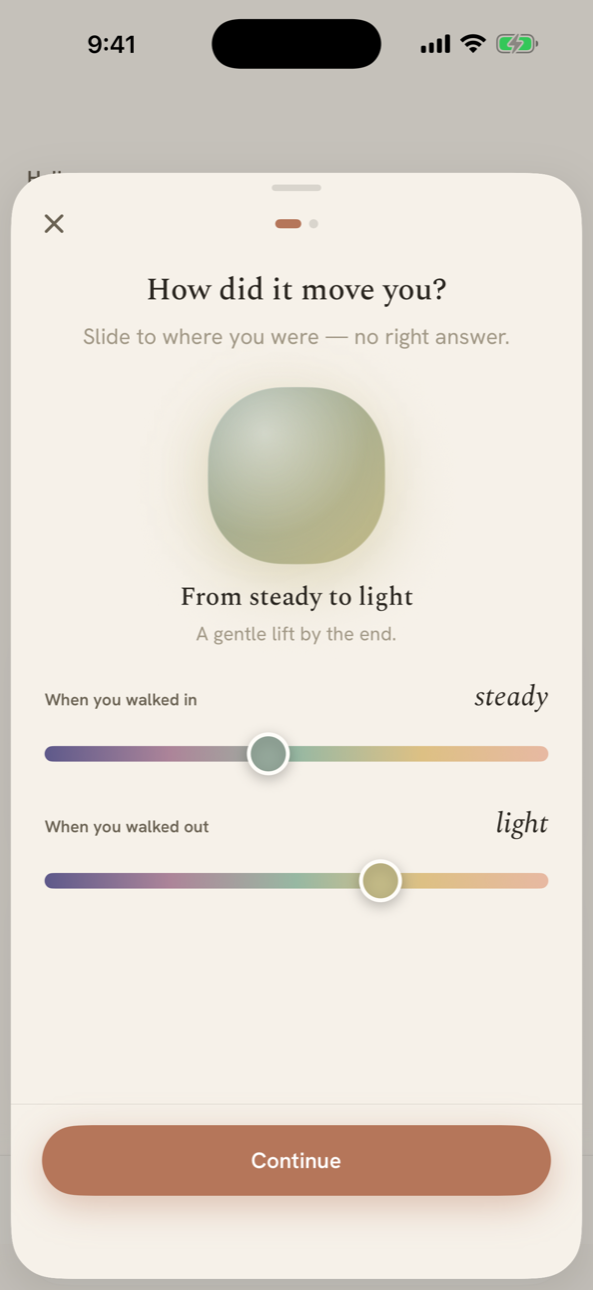
log a session in under 90 seconds: mood going in and coming out (1–10), what came up, a headline, optional homework, and an intention for next time.
See your progress instead of guessing at it
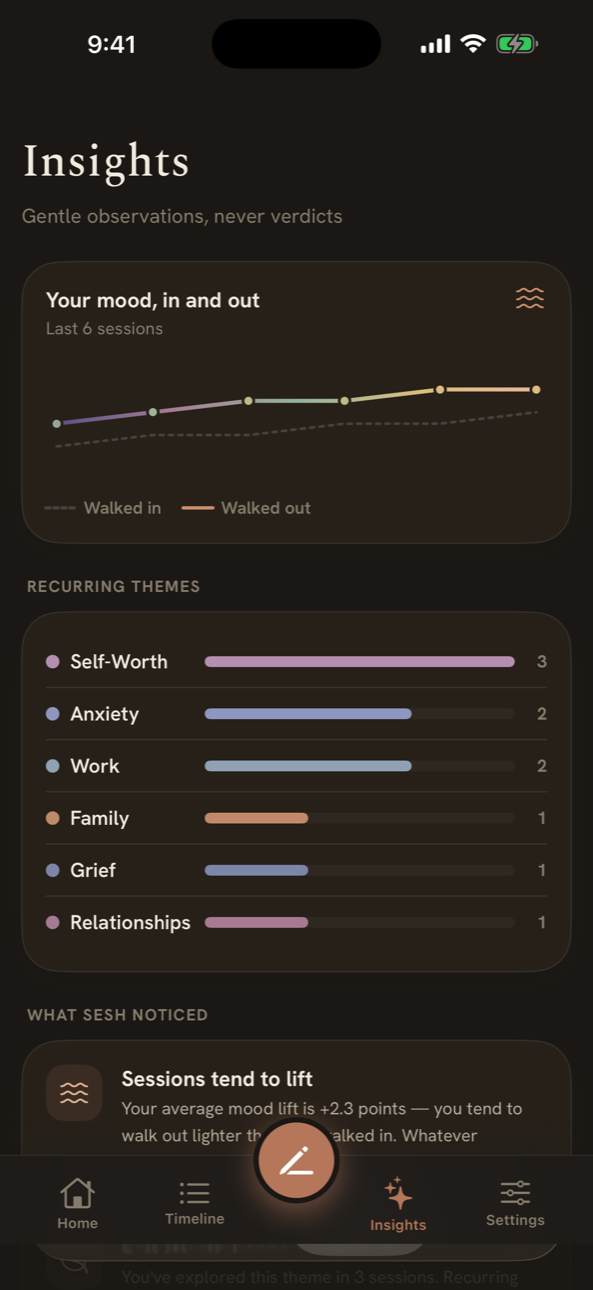
tag recurring themes on each session and let the patterns surface over weeks of therapy.
Never re-explain yourself to your therapist
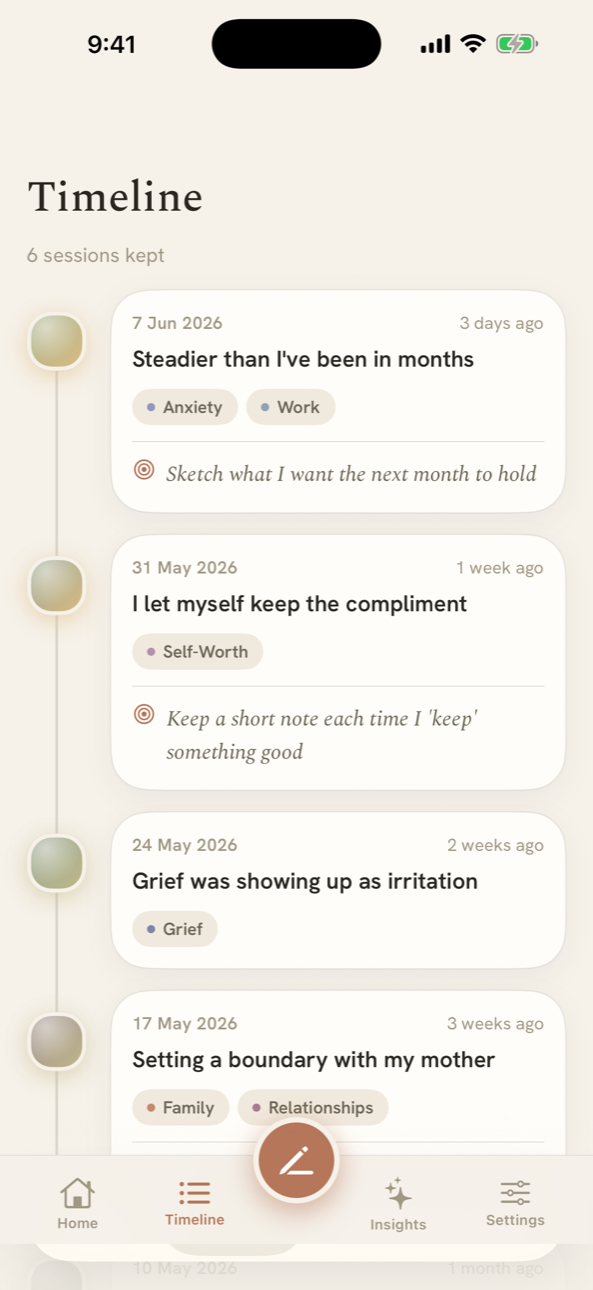
a calm, searchable timeline of every session you've logged, free to revisit forever.
Turn vague goals into kept ones
set goals with your therapist and check in on them session by session: tracked, never nagged.
Know what's actually shifting (Plus)
Insights reveal your mood trend across recent sessions, your most recurring themes, and deeper pattern detection.
Walk in prepared, every time (Plus)
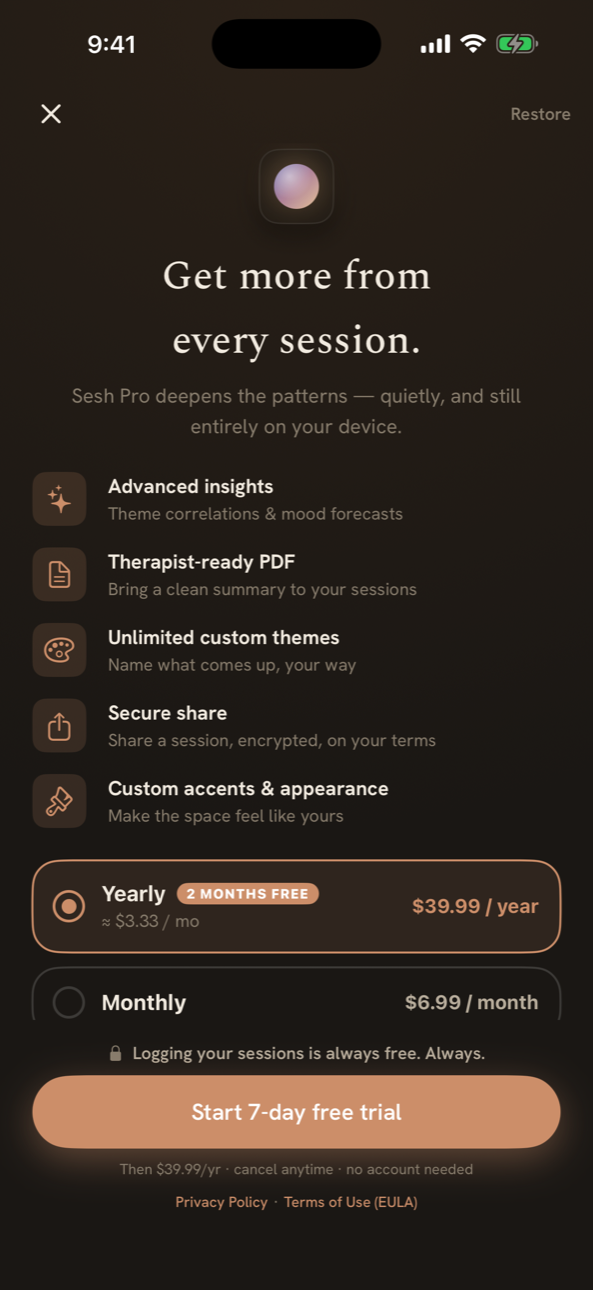
export a clean, therapist-ready PDF summary to share: only when you choose to.
Catch the mid-week thought before it's gone
pre-session prep plus a between-session capture note keep what surfaces until you're ready for it.
Your therapy stays yours
100% on-device storage (SwiftData), no account, no cloud sync, and an optional Face ID app lock.
Make it feel like yours (Plus)
custom themes and alternate app icons, so the journal matches how you actually want to show up.
No surveillance
optional session reminders and opt-in anonymous analytics that's off by default and never sees your moods, themes, or notes.
A look inside
See it in your hands.
How it works
Up and running in under two minutes.
- 01
After a session, open Sesh and log it
set your mood in and out, jot what came up and a headline, and add optional homework, themes, and an intention.
- 02
Each session lands on your private timeline, stored on-device — no account to create, nothing uploaded.
- 03
Set goals with your therapist and check in on them as you log sessions.
- 04
Once you've logged enough sessions, Insights reveals your mood trend and recurring themes (a Sesh Plus feature).
- 05
When you want, export a clean PDF summary to share with your therapist (Sesh Plus).
A note from the studio
“I built Sesh after a year where my therapy felt like it was stalling — not because the sessions were bad, but because I'd forget the breakthroughs by the next week. I wanted a private place to hold what came up, watch the patterns surface, and walk into the next session already knowing where I left off. It isn't a replacement for a therapist; it's a high-fidelity container for the work you're already paying for.”
Questions
The honest answers.
Is Sesh private? Where is my therapy data stored?
Everything you write — sessions, moods, themes, goals, and notes — is stored locally on your device (SwiftData on iOS) and never leaves it. There's no Sesh account and no server that holds your content, and you can lock the whole app behind Face ID.
Does Sesh use the cloud or send my notes to an AI?
No. There's no cloud sync and no account, so your reflections are never uploaded or fed to any AI. Analytics and crash reporting are opt-in and off by default, and even when on they only ever see anonymous event names — never your moods, themes, or notes.
Is Sesh free?
Yes — logging sessions, your full timeline, and goals are free forever, with no account required. Sesh Plus adds Insights (mood trends, recurring themes, pattern detection), therapist-ready PDF export, and custom themes and icons. Plus is $39.99/year with a 7-day free trial, or $6.99/month, billed through the App Store.
Who is Sesh for?
It's built for adults in ongoing talk therapy who want to hold onto what came up between sessions. If you've ever walked out with a breakthrough and lost it by the next week, Sesh is the bridge — log a session in under 90 seconds and let the recurring themes surface over time.
How is Sesh different from a notes app or a journal like Day One?
A blank page or a general journal doesn't know you're in therapy. Sesh is shaped around the session — mood in and out, recurring themes, a headline, and homework — so the structure does the remembering for you. And unlike a mood tracker, it favors narrative recall over clinical dashboards.
Can I share my sessions with my therapist?
Yes, if you choose to. Sesh Plus exports a clean PDF summary you can bring to a session. Nothing is ever shared automatically — your content only leaves your device when you deliberately export it.
Does it work offline, and do I need an account?
Sesh works fully offline and needs no account — because everything lives on your device, you can log a session on the train home from therapy with no signal. You can also cancel Plus anytime in your App Store subscription settings.
Is Sesh a replacement for therapy?
No. Sesh is a private container for the work you're already doing with a therapist — it's not a substitute for professional care, diagnosis, or treatment, and it doesn't give medical or mental-health advice. Think of it as a way to make the therapy you're paying for stick.
Everything you write — sessions, moods, themes, goals, and notes — is stored locally on your device (SwiftData on iOS, Room on Android). It never leaves your device.
From the journal
Notes on the intentional life.
- 01
Why Therapy Made You Angry at Your Parents (and What to Do With That Anger)
Feeling angry at your parents after therapy? That anger isn't a setback. It's grief arriving late, and it carries a message you were never allowed to hear.
2026-10-26
7 min read
- 02
What Does My Therapist Write About Me? What's Really in Those Notes (and Whether You Can See Them)
Wondering what does my therapist write about me? Here's what's actually in those notes, what the law lets you see, and why the version in your head is harsher than the real one.
2026-10-25
7 min read
- 03
Overthinking What My Therapist Said: Why One Sentence Replays for Weeks
Overthinking what your therapist said? Why one offhand line can replay for weeks, what your mind is really trying to finish, and how to turn the loop into insight.
2026-10-25
6 min read
- 04
Why Your Therapy Breakthrough Sounds So Obvious When You Say It Out Loud
Your therapy breakthrough sounds obvious, even trite, once you try to explain it. Here is why the words shrink, and why the change underneath is still real.
2026-10-24
7 min read
- 05
Therapy Changing My Relationships: Why People Push Back When You Start to Grow
Is therapy changing your relationships? When you stop overfunctioning, the people closest to you often push back. Here's why that happens, and how to stay steady.
2026-10-24
7 min read
- 06
Afraid of Getting Better in Therapy? Why Part of You Doesn't Want to Heal
Afraid of getting better in therapy? It isn't sabotage. It's ambivalence, and the part of you that resists change is protecting something real. Here's what it is.
2026-10-24
7 min read
- 07
Realizations After Therapy: Why the Real Insight Hits Hours After Your Session Ends
Realizations after therapy often show up hours later, in the shower or on the drive home. Here's why your mind works this way, and how to catch the insight before it fades.
2026-10-23
6 min read
- 08
My Therapist Forgot What I Told Them: Why It Hurts So Much (and What to Do Next)
Your therapist forgot what you told them, and it stung more than it should have. Here's what that hurt says about being held in mind, and how to bring it up.
2026-10-23
7 min read
- 09
Why You Keep Apologizing in Therapy When You've Done Nothing Wrong
Why do I apologize so much in therapy? The sorry reflex is a fawn response, not politeness. Here's what over-apologizing is protecting — and how to stop.
2026-10-22
6 min read
- 10
Feeling Guilty About Paying for Therapy? What That Guilt Is Really Measuring
Feeling guilty about paying for therapy is rarely about the money. Here's what the guilt is actually measuring, and how to tell a real budget limit from an old belief.
2026-10-22
7 min read
- 11
Why You Can Give Great Advice but Can't Take It: Solomon's Paradox, Explained
Why can I give advice but not take it? Solomon's paradox explains the distance problem — and how self-distancing lets you finally counsel yourself.
2026-07-12
7 min read
- 12
Why Therapy Is Different From Talking to a Friend (Even a Really Good One)
Why is therapy different from talking to a friend? Co-rumination research shows venting can deepen a friendship and worsen anxiety at once — here's what the frame changes.
2026-07-12
7 min read
- 13
Should You Tell Your Partner What You Talk About in Therapy?
Should you tell your partner what you talk about in therapy? Why "how was your session?" is so hard to answer — and how to share without losing the work.
2026-07-12
7 min read
- 14
Why Won't My Therapist Give Me Advice? The Real Reason They Won't Tell You What to Do
Why won't my therapist give me advice? Because handed answers don't hold. The psychology of guided discovery — and how to get real direction anyway.
2026-07-11
7 min read
- 15
What to Say in Your First Therapy Session (When You Have No Idea Where to Start)
Don't know what to say in your first therapy session? What actually happens at intake, why you don't need a polished story, and how to tell if a therapist fits.
2026-07-11
7 min read
- 16
Why Is Therapy Only 50 Minutes? What the Fifty-Minute Hour Is Actually Doing
Wondering why is therapy only 50 minutes when you finally get somewhere at minute 44? The clock isn't cutting you off. It's the reason you got there at all.
2026-07-10
7 min read
- 17
Running Into Your Therapist in Public: Why It Feels So Strange (and What to Do)
Running into your therapist in public can feel weirdly like being caught. Here's the psychology behind the jolt — and how to handle the grocery-aisle moment.
2026-07-10
7 min read
- 18
Why You Spend Half of Therapy Talking About Your Week (and How to Stop)
If you find yourself talking about your week in therapy until the clock runs out, it isn't small talk. It's a well-mannered escape hatch — and there's a way out.
2026-07-09
7 min read
- 19
Why You Lie to Your Therapist (Even Though You're Paying Them to Hear the Truth)
Lying to your therapist is almost universal, and it's rarely about deception. Here's what your omissions protect, and how to bring them into the room.
2026-07-09
7 min read
- 20
Testing Your Therapist: Why You Push to See If They'll Give Up on You
Testing your therapist isn't manipulation — it's how your mind checks whether an old belief is still true. What unconscious testing looks like, and how to use it.
2026-07-09
7 min read
- 21
Why You Wonder If You're Your Therapist's Favorite Client
Wondering if you're your therapist's favorite client, or feeling jealous of their other clients? Here's the attachment mechanism behind it — and why the wish makes sense.
2026-07-08
6 min read
- 22
Why You Defend Your Parents in Therapy (Even When They're the Reason You're There)
Why do I defend my parents in therapy? The reflex to say 'but they did their best' isn't fairness — it's an old loyalty bind. Here's what's really happening.
2026-07-08
6 min read
- 23
Why Your Therapist's Vacation Hits Harder Than You Expected
Feeling abandoned when your therapist goes on vacation? Here's the attachment psychology behind therapist break anxiety — and why the ache is a sign of real work, not weakness.
2026-07-07
7 min read
- 24
Why You Feel Like a Burden to Your Therapist (and What That Fear Is Really About)
Feeling like a burden to your therapist usually isn't about them. Here's what the fear that you're 'too much' in therapy is actually telling you.
2026-07-07
6 min read
- 25
Why Therapy Feels Like a One-Sided Relationship (and Why It's Supposed To)
Why therapy feels one-sided: you know almost nothing about your therapist while they know your whole inner life. The asymmetry isn't coldness — it's the treatment.
2026-07-06
6 min read
- 26
Why Saying Something Out Loud in Therapy Makes It Feel Smaller
Why saying things out loud in therapy helps: the science of affect labeling, how naming a feeling quiets it, and why the words matter more than the advice.
2026-07-06
6 min read
- 27
Why You Don't Do Your Therapy Homework (It's Not Laziness — It's Avoidance)
Why you don't do your therapy homework has little to do with laziness. It's avoidance doing its job — here's the psychology behind the skipped worksheet, and what actually helps.
2026-07-04
6 min read
- 28
Why Do I Dread Therapy Before Every Session? What Pre-Session Anxiety Actually Means
Why do I dread therapy when it always helps? The psychology of pre-session anxiety — affective forecasting, avoidance, and why the dread fades at the door.
2026-07-04
6 min read
- 29
Why Am I So Tired After Therapy? The Real Reasons Sessions Leave You Exhausted
Asking "why am I so tired after therapy?" Post-session exhaustion is real and explainable. Here's the psychology behind the crash — and how to plan around it.
2026-07-04
7 min read
- 30
Why Is Silence in Therapy So Uncomfortable? What the Pause Is Actually For
Why is silence in therapy so uncomfortable? The science of conversational gaps, what your therapist's quiet is for, and how to let the pause do its work.
2026-07-03
7 min read
- 31
Dreaming About Your Therapist? What It Means and Why It's Completely Normal
Dreaming about your therapist is common — and often a sign the work is landing. What dream science says it means, and whether to bring it up in session.
2026-07-03
7 min read
- 32
Hearing Your Therapist's Voice in Your Head? That's Internalization, and It Means It's Working
Hearing your therapist's voice in your head between sessions isn't strange — it's internalization, one of the most reliable signs therapy is working.
2026-07-02
6 min read
- 33
Why You Rehearse What to Say in Therapy Before Every Session
Rehearsing what to say in therapy before a session feels like good preparation, but the script can quietly keep you safe. Here's the psychology of why you do it.
2026-06-27
7 min read
- 34
Why You Downplay Your Problems in Therapy (and Call It Being Reasonable)
Downplaying your problems in therapy can feel like maturity, but minimizing your feelings often hides the very material the session needs. Here's why you do it.
2026-06-27
7 min read
- 35
Crying in Therapy: Why It's So Hard to Let Yourself Cry in Front of Your Therapist
Crying in therapy can feel exposing, even shameful. Here's the science of why you hold tears back in session—and what changes when you finally let them come.
2026-06-26
7 min read
- 36
Transference in Therapy: Why You React to Your Therapist Like Someone From Your Past
Transference in therapy explains why you feel strangely angry, fond, or anxious toward your therapist. Here's what's actually happening — and why it's useful.
2026-06-24
6 min read
- 37
Why You Laugh When You Talk About Something Painful in Therapy
Laughing in therapy when you talk about something sad isn't avoidance or fakeness. Here's what nervous laughter is really doing—and why the laugh marks the exact spot that matters.
2026-06-23
6 min read
- 38
The Vulnerability Hangover: Why You Feel Embarrassed After Opening Up in Therapy
A vulnerability hangover after therapy—that cringe of having said too much—is a normal shame response, not proof you overshared. Here's what's happening and how to ride it out.
2026-06-23
6 min read
- 39
Intellectualizing in Therapy: Why You Analyze Your Feelings Instead of Feeling Them
Intellectualizing in therapy means narrating your pain instead of feeling it. Here's why your mind reaches for analysis—and how to let the feeling back in.
2026-06-23
7 min read
- 40
Why You Want to Cancel Therapy Right When It's Starting to Work
Wanting to cancel therapy the week it finally starts to help isn't flakiness — it's avoidance doing its job. Here's the psychology, and what to do instead of skipping.
2026-06-22
6 min read
- 41
Why You Go Blank When Your Therapist Asks How You Feel
If you go blank in therapy when asked how you feel, you're not avoiding the work—you're hitting a real skill gap. Here's the science of naming emotions, and how to build it.
2026-06-22
6 min read
- 42
Why You Can't Remember Your Real Problems Once You're in the Therapy Room
Why you forget your problems in therapy the moment you sit down — how state-dependent memory hides the week's distress, and a simple way to bring it back.
2026-06-21
7 min read
- 43
People-Pleasing Your Therapist: Why You Perform in Session (and How to Stop)
People-pleasing in therapy is so common it can quietly stall your progress. Here's why you perform for your therapist—and how honesty in session becomes the real work.
2026-06-20
6 min read
- 44
What to Do When You Feel Upset With Your Therapist
Feeling upset with your therapist isn't a sign therapy is failing. Learn how rupture and repair in the therapeutic alliance often becomes the most useful work you do.
2026-06-17
7 min read
- 45
How to Tell Your Therapist Something Isn't Working (Without Quitting)
Learning how to tell your therapist something isn't working is a skill, not a betrayal. What a 'rupture' is, why naming it helps, and the exact words to start.
2026-06-14
6 min read
- 46
Winding Down Therapy Without Losing What You Gained
Ending therapy well is its own skill. How to taper off, become your own therapist, and keep the progress you made when the weekly hour is gone.
2026-06-11
6 min read
- 47
Doorknob Confessions: Why You Bring Up the Hard Thing as Therapy Ends
Doorknob confessions in therapy — why you save the real thing for the last minute of a session, what the timing reveals, and how to bring it up sooner.
2026-06-11
7 min read
- 48
Reading Your Own Patterns: What Recurring Themes Reveal
The same subject keeps surfacing in therapy and you barely notice. How to read recurring themes in therapy — and why the patterns you can't see hold the most.
2026-06-09
6 min read
- 49
Types of Therapy, and How to Tell Which One Fits You
CBT, psychodynamic, IFS, EMDR — the different types of therapy aren't interchangeable. A plain guide to how the major approaches differ and how to find the right fit.
2026-06-05
7 min read
- 50
When You Have Nothing to Talk About in Therapy
You sit down, your therapist asks where you'd like to start, and your mind goes blank. What having nothing to talk about in therapy really means — and what to do.
2026-06-01
6 min read
- 51
The Therapy Plateau: When Sessions Stop Feeling Like Progress
Therapy used to feel like movement. Now you circle the same ground. What a therapy plateau really means, why progress stalls, and how to tell stuck from done.
2026-05-26
6 min read
- 52
Why Therapy Insights Fade — and What Memory Has to Do With It
The breakthrough felt unforgettable in the room. A week later it's gone. Why therapy insights fade, what memory consolidation has to do with it, and how to hold on.
2026-05-21
7 min read
- 53
Feeling Worse After Therapy Doesn't Mean It's Not Working
If you leave some sessions heavier than you arrived, you might be doing it right. Why feeling worse after therapy is often a sign of progress, not failure.
2026-05-14
6 min read
- 54
How to Get More Out of Every Therapy Session
Most of us walk into therapy empty-handed and hope the hour fills itself. Here is how to get more out of every therapy session by arriving with a thread to pull.
2026-05-07
6 min read
- 55
Between Therapy Sessions Is Where Change Actually Happens
The insight that landed in the room is just a seed. What you do between therapy sessions — in the other 167 hours — is what actually changes things.
2026-04-26
5 min read
- 56
Keeping Therapy Notes Private Is a Practice, Not a Setting
Keeping therapy notes private isn't just about app settings. It's an active practice — the series of small choices that make honest self-reflection possible.
2026-04-17
4 min read
- 57
Keeping Your Therapy Private Is a Practice, Not Just a Setting
Keeping therapy private isn't only about which app you use — it's a daily practice of boundaries, honesty, and protecting the space where real change happens.
2026-04-08
4 min read
- 58
The Post-Therapy Ritual That Makes the Other Six Days Count
Between sessions is where therapy actually works. Building a steady post-therapy ritual takes ninety seconds — and compounds quietly over months.
2026-03-30
5 min read
- 59
What to Write Down After Therapy (and What to Skip)
A practical, kind guide to what to write down after therapy — the four things that pay off and the two that quietly waste your time.
2026-03-21
6 min read
- 60
Why Your Therapy Notes Shouldn't Live in the Cloud
A plain-English case for keeping therapy notes private: why the cloud is the wrong place for them, and what private therapy journaling actually looks like.
2026-03-12
7 min read