Available now

Recall

Beautiful, fast flashcards that remember for you.

A calm, modern flashcard app built on the FSRS spaced-repetition scheduler. Import your Anki .apkg, CSV, or Quizlet decks on-device, study with a tap-to-reveal loop and four predicted-interval grades, and watch your retention in a real stats dashboard. Fully offline, no account, no ads.

Download on the App StoreAndroid — coming soonFree tier · lifetime offered · $9.99/yr

Recall offers an auto-renewing subscription. Payment is charged to your App Store or Google Play account; it renews automatically unless cancelled at least 24 hours before the period ends, and you can manage or cancel anytime in your account settings. Terms and Privacy Policy.

9:41

Recall

education

Beautiful, fast flashcards that remember for you

FSRS spaced repetition
On-device import (the wedge)
Three card types
Distraction-free study loop
Open Recall

Account

Not required

Analytics

Opt-in & anonymous

Your data

Stays on device

Ads & trackers

Zero

What you get

Built for exactly this — and nothing you don't need.

FSRS spaced repetition

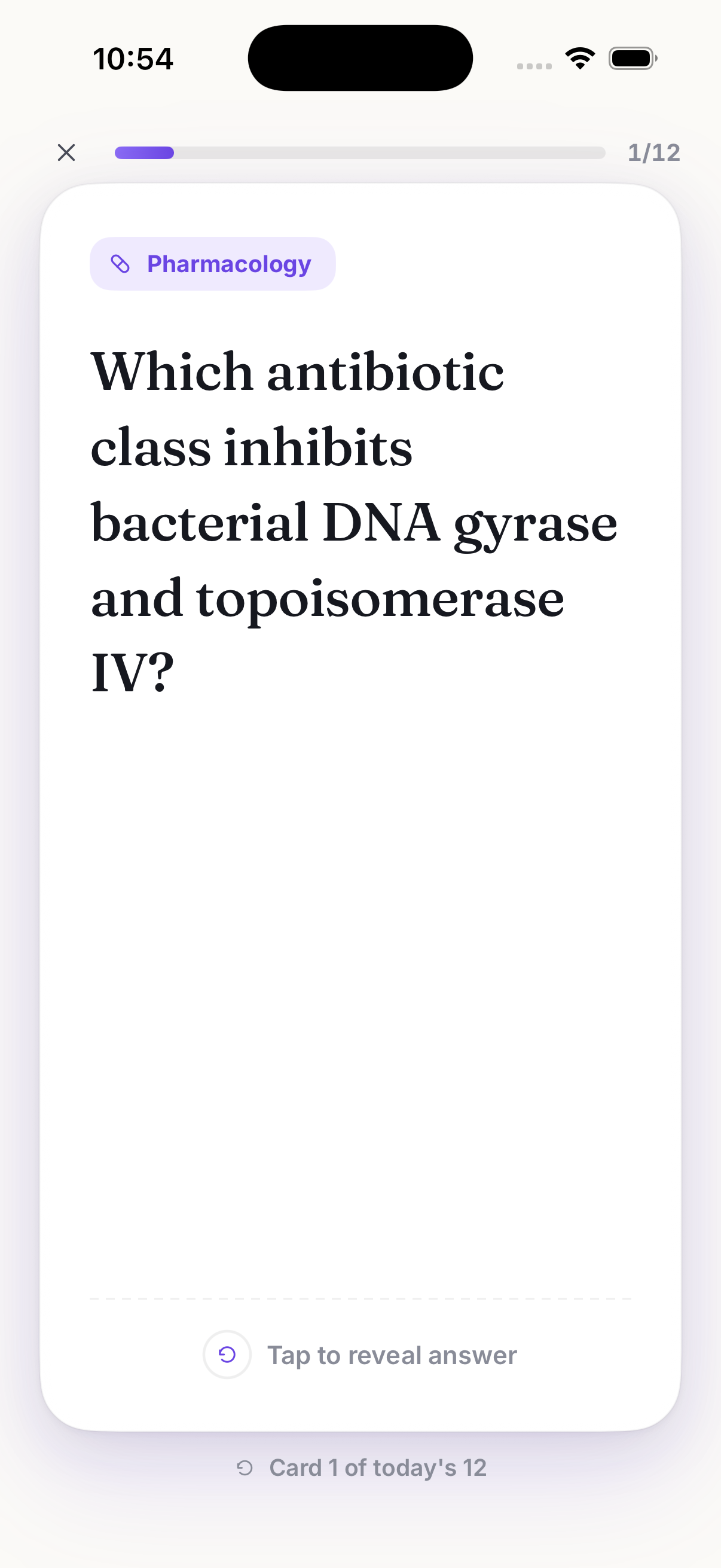
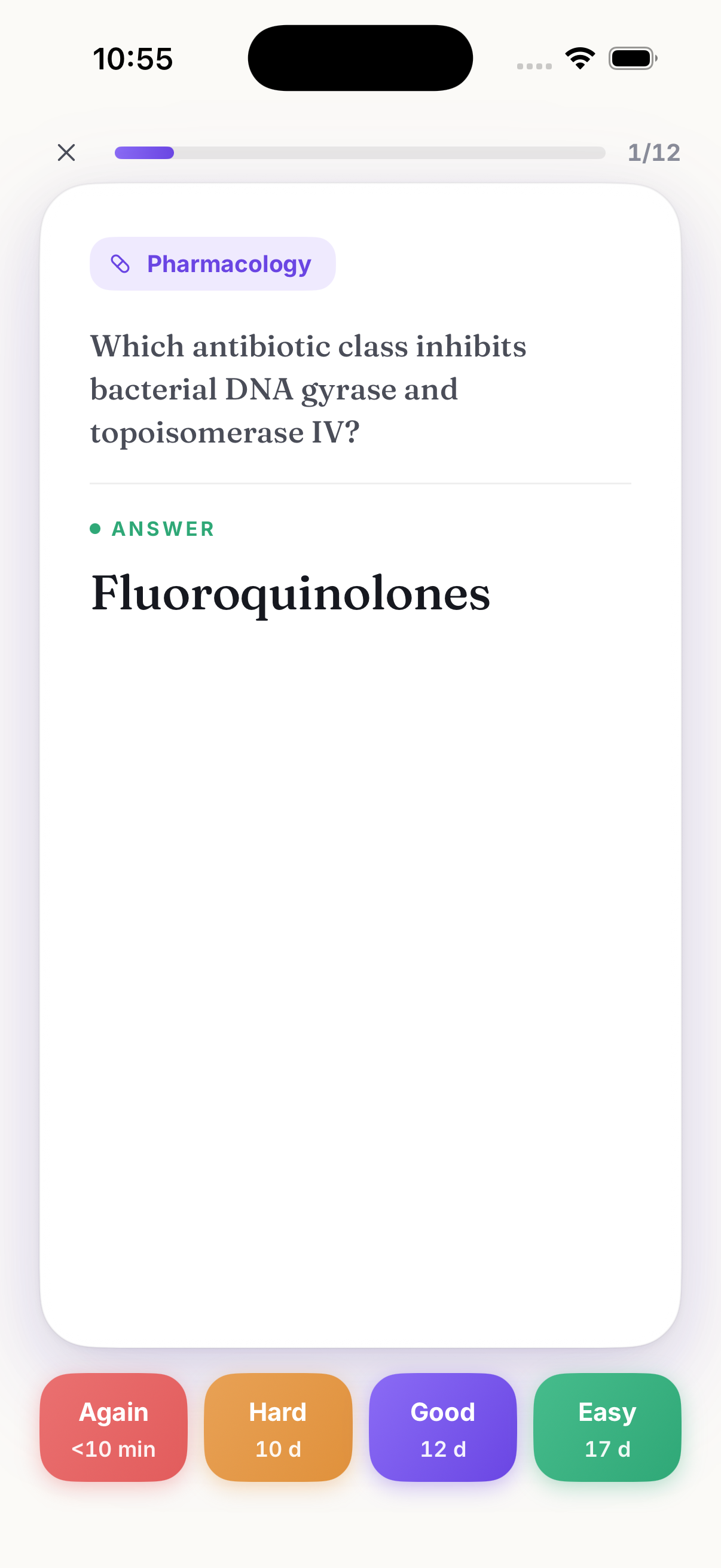
a full, modern scheduler (not crippled on the free tier): reveal a card, then grade it Again / Hard / Good / Easy, with the predicted next interval shown on each button before you tap.

On-device import (the wedge)

Anki .apkg files (decks, notes & embedded media), CSV files, and pasted Quizlet exports: everything is parsed locally, with no account and nothing uploaded.

Three card types

Basic, Basic + Reverse, and Cloze: with a live cloze preview that shows the blanked question and revealed answer as you type.

Distraction-free study loop

progress bar, tap-to-reveal, one-tap grading, and undo of your last grade (which fully reverts the card's FSRS memory).

Stats dashboard

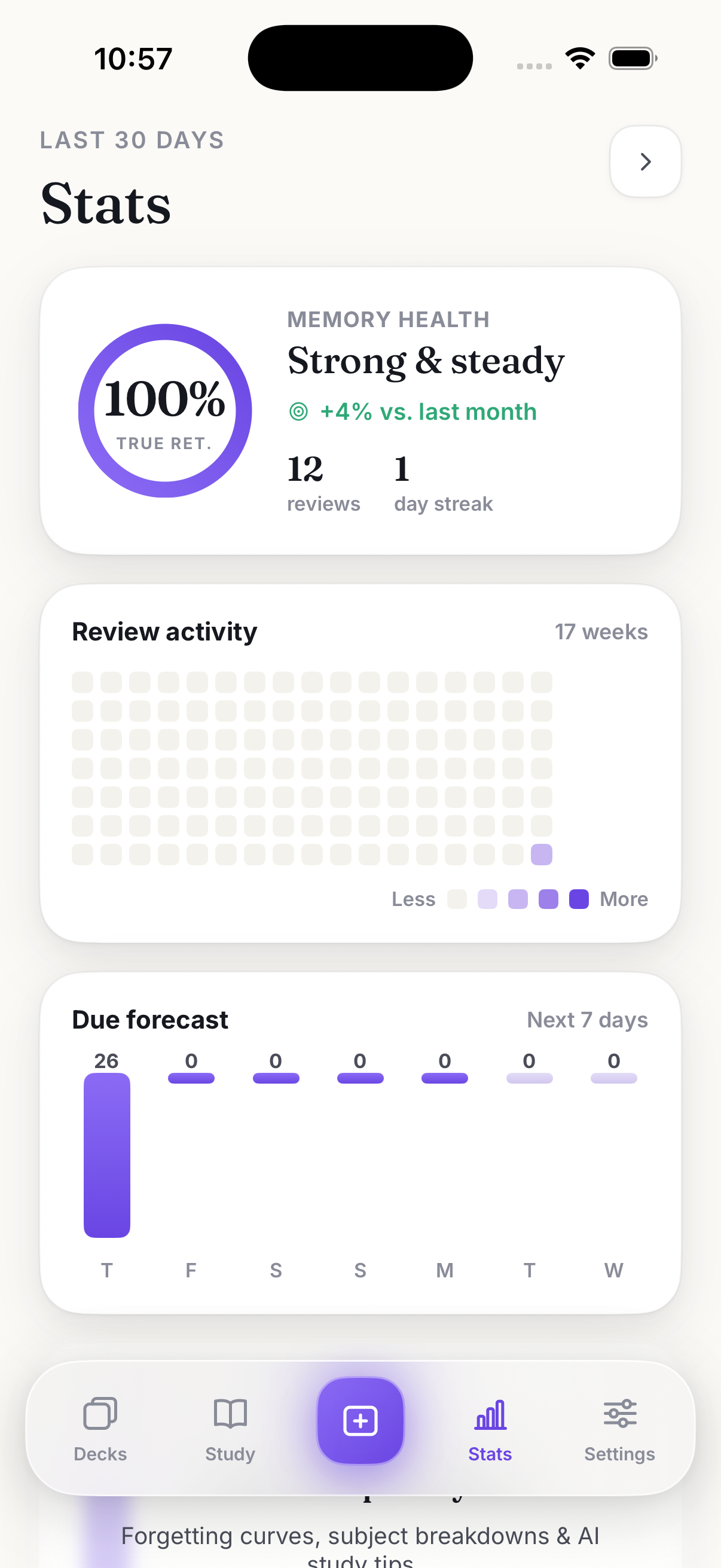
a retention ring, GitHub-style review heatmap, due-cards forecast bar chart, current streak, retention change vs. the prior window, and retention broken down by subject.

Image & audio cards (Recall Pro)

attach a photo or audio clip to a card, shown and playable under the answer during study.

Custom FSRS retention targets (Recall Pro)

set your desired retention percentage (80–97%) and the scheduler adapts; free users stay at the default 90%.

Light / Dark / System appearance, configurable daily limits (new cards per day, max reviews per day), haptics on grade, and local due-card reminders.

Fully offline and private

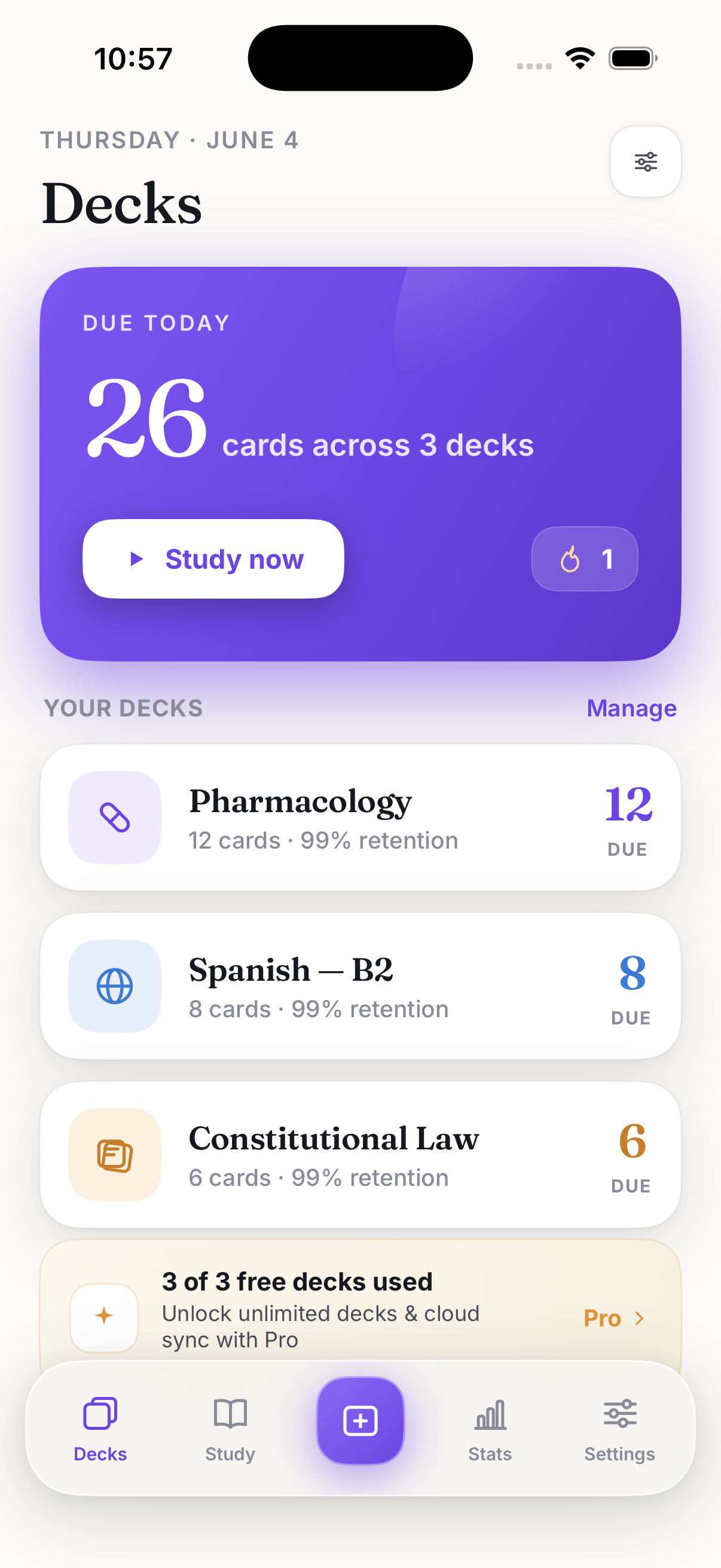
all decks, reviews, and imports live on-device only: no cross-device sync, no sign-in, and no ads, ever. Pro adds full CSV export of your decks.

A look inside

See it in your hands.
Recall screenshot 1Recall screenshot 2Recall screenshot 3Recall screenshot 4

How it works

Up and running in under two minutes.

  1. 01

  2. 02

  3. 03

  4. 04

  5. 05

  6. 06

A note from the studio

I studied for exams on Anki for years and loved the science but never the app. Quizlet felt like a social network with a paywall. I wanted something quiet, fast, and affordable — that respected the work you already put into building your decks.

Questions

The honest answers.

Can I import my Anki decks?

Yes. Tap Import, pick your .apkg file, and Recall loads all your cards and embedded images on-device. No internet connection required and no lock-in — your decks stay yours.

What is FSRS and why does it matter?

FSRS (Free Spaced Repetition Scheduler) is the modern open-source algorithm that predicts forgetting more accurately than the classic SM-2 algorithm Anki defaulted to for 15 years. You see four rating buttons — Again, Hard, Good, Easy — and Recall shows the predicted next review interval for each so you can make an informed choice.

Does my data sync across devices?

Recall is fully on-device — your decks and review history live on the device you're using. No account is required, and nothing leaves your device.

Is it really cheaper than Anki?

Yes. AnkiMobile is $24.99 on iOS with no free study tier. Recall Pro is $19.99 lifetime and includes a free tier of up to 3 decks and 300 cards before you need to upgrade.

Do you show ads?

Never. Recall has no ads on any tier. Recall Pro is a fair trade — a small one-time or annual payment keeps the lights on without selling your attention or your data.

Do I need to create an account?

No account, email, or sign-up required. Recall works fully offline the moment you open it.

All your decks, cards, review history, scheduling state, and imported media are stored locally on your device. There is no Lumen Labs server copy — nothing leaves your device.

From the journal

Notes on the practice.

  1. 01

    Why You Can't Remember Names: The Baker/baker Paradox, Explained

    Forgetting a name seconds after hearing it isn't rudeness or age — it's the Baker/baker paradox. Here's why you can't remember names, and how to finally fix it.

    2026-07-12

    7 min read

  2. 02

    The Tip-of-the-Tongue Phenomenon: Why Words Get Stuck and How to Free Them

    The tip-of-the-tongue phenomenon isn't your memory failing — it's a broken link between meaning and sound. The science of why words get stuck, and how to get them back.

    2026-07-12

    6 min read

  3. 03

    Cognitive Offloading: Why You Can't Remember Anything You Google

    Cognitive offloading and memory: what the Google effect does to your brain when every fact lives in your phone — and how to decide what still deserves to be known.

    2026-07-12

    7 min read

  4. 04

    Why You Remember Song Lyrics but Forget What You Study

    Why do I remember song lyrics so easily but forget what I study? Because songs get perfect memory conditions — and you can steal every one of them, no melody required.

    2026-07-11

    6 min read

  5. 05

    Handwriting vs Typing Notes: Why Writing Less Helps You Remember More

    Handwriting vs typing notes: what memory research really shows — the advantage was never the pen, it's the slowness that forces your brain to compress meaning.

    2026-07-11

    7 min read

  6. 06

    Exercise and Memory Consolidation: Why a Workout After Studying Helps It Stick

    Does exercise after studying improve memory? Research suggests timing matters more than intensity — and the window that worked best wasn't the one anyone expected.

    2026-07-10

    7 min read

  7. 07

    Test Anxiety and Memory Retrieval: Why You Blank on Exams You Actually Knew

    Test anxiety and memory retrieval collide in the exam room: the fact is still there, but stress locks the door. Here's the mechanism — and how retrieval practice makes memory stress-proof.

    2026-07-09

    7 min read

  8. 08

    Encoding Variability: Why Studying the Same Fact in Different Ways Makes It Stick

    Encoding variability explains why one perfect flashcard fails you at the worst moment — and how varying how you study the same fact builds memory that survives the real world.

    2026-07-09

    7 min read

  9. 09

    Divided Attention and Memory: Why Studying With Your Phone Nearby Ruins Encoding

    Divided attention and memory don't mix — but only in one direction. Studying with your phone nearby quietly destroys what you encode, while barely touching what you can recall.

    2026-07-09

    7 min read

  10. 10

    Transfer-Appropriate Processing: Why You Should Study the Way You'll Be Tested

    Transfer-appropriate processing explains why you should study the way you'll be tested — match your practice to the retrieval you'll actually need, and memory follows.

    2026-07-08

    7 min read

  11. 11

    The Self-Reference Effect: Why You Remember Things That Relate to You

    The self-reference effect explains why facts tied to your own life stick better. Learn the memory science and how to use self-referencing to study smarter.

    2026-07-07

    7 min read

  12. 12

    Retrieval-Induced Forgetting: Why Practicing Some Facts Can Make You Forget Related Ones

    Retrieval-induced forgetting explains why recalling some facts can quietly weaken your memory for related ones — and how to study so nothing you learned slips away.

    2026-07-07

    7 min read

  13. 13

    The Illusion of Knowing: Why Feeling Sure You've Learned It Isn't Proof

    The illusion of knowing tricks you into thinking you've mastered material when you haven't. Here's the science of why confidence lies — and how to test it.

    2026-07-06

    6 min read

  14. 14

    Overlearning: Why Drilling a Card You Already Know Wastes Your Study Time

    Does overlearning improve long-term memory? The research says drilling a flashcard past the point of mastery buys short-lived confidence — here's what to do with that time instead.

    2026-07-06

    6 min read

  15. 15

    The Production Effect: Why Saying It Out Loud Helps You Remember

    Does saying things out loud help you remember? Yes — psychologists call it the production effect. Here's how it works and how to study with your voice.

    2026-07-04

    6 min read

  16. 16

    The Keyword Mnemonic: How to Remember Foreign Vocabulary With Images

    The keyword mnemonic method turns unfamiliar foreign words into vivid images you can actually recall. What the research shows — and where the trick quietly fails.

    2026-07-04

    6 min read

  17. 17

    The Feynman Technique: Why Explaining It Simply Reveals What You Don't Know

    The Feynman Technique for studying works because explaining an idea in plain words exposes gaps that rereading hides. Here's the science, and how to use it well.

    2026-07-03

    6 min read

  18. 18

    Storage Strength vs Retrieval Strength: Why You Never Truly Forget

    Storage strength vs retrieval strength explains why 'forgotten' knowledge comes back fast — and how to study so what you learn stays reachable for good.

    2026-07-03

    6 min read

  19. 19

    Levels of Processing: Why How Deeply You Think Decides What You Remember

    Levels of processing theory explains why some study sessions stick and others vanish: memory depends less on time spent than on how deeply you think about meaning.

    2026-07-03

    7 min read

  20. 20

    The Pretesting Effect: Why Guessing Before You Learn Helps You Remember

    The pretesting effect shows that guessing before you learn — even guessing wrong — makes new material stick. Here's the science, and how to use it when you study.

    2026-07-02

    6 min read

  21. 21

    The Von Restorff Effect: Why the Odd One Out Is the Thing You Remember

    The von Restorff effect explains why distinctive information is easier to remember. Learn how the isolation effect works and how to make study material stand out.

    2026-06-27

    7 min read

  22. 22

    The Serial Position Effect: Why You Forget the Middle of What You Study

    The serial position effect explains why the middle of a list or deck slips away while the start and end stick. Here's the memory science—and how to study around it.

    2026-06-27

    7 min read

  23. 23

    Context-Dependent Memory: Why Where You Study Shapes What You Recall

    Context-dependent memory explains why facts learned in one place can vanish in another—and how varying where you study makes recall more reliable anywhere.

    2026-06-26

    7 min read

  24. 24

    Chunking in Memory: How to Remember Complex Information by Grouping It

    Chunking is why a chess master remembers a board at a glance. Learn how grouping information bypasses working-memory limits—and how to use chunking to memorize complex material.

    2026-06-26

    7 min read

  25. 25

    Why Similar Flashcards Get Confused: Memory Interference, Explained

    Memory interference is why similar flashcards blur together. Learn how proactive and retroactive interference cause forgetting—and how to write cards that don't compete.

    2026-06-24

    6 min read

  26. 26

    The Generation Effect: Why Producing an Answer Beats Recognizing It

    The generation effect explains why producing an answer from memory beats rereading it. Learn how generating answers strengthens recall—and how to study with it.

    2026-06-23

    7 min read

  27. 27

    Desirable Difficulties: Why Studying That Feels Harder Builds Stronger Memory

    Desirable difficulties explain why effortful, slower studying beats smooth review. Learn the storage vs. retrieval strength science—and how to make study struggle work for you.

    2026-06-23

    7 min read

  28. 28

    The Hypercorrection Effect: Why Getting It Wrong Helps You Remember

    The hypercorrection effect explains why confident mistakes are easier to fix than quiet ones. Learn why getting it wrong, then correcting it, makes memory stick.

    2026-06-22

    7 min read

  29. 29

    How to Use a Memory Palace: The Method of Loci, Explained

    Learn how to use a memory palace—the ancient method of loci—to memorize almost anything by turning abstract facts into vivid places you can walk through in your mind.

    2026-06-22

    6 min read

  30. 30

    Elaborative Interrogation: How Asking "Why" Makes Facts Stick

    Elaborative interrogation is a study technique where you ask 'why is this true?' to remember facts longer. Here's the science behind it and how to use it.

    2026-06-22

    7 min read

  31. 31

    Dual Coding: How Pairing Words With Images Helps You Remember More

    Dual coding theory explains why pairing words with images helps you remember more. Learn how visual and verbal memory work together — and how to use it.

    2026-06-21

    7 min read

  32. 32

    How Sleep Helps Memory Consolidation: Why What You Study Before Bed Sticks

    How sleep helps memory consolidation, what really happens to new facts overnight, and why reviewing before bed makes learning stick. A practical, science-grounded guide.

    2026-06-20

    7 min read

  33. 33

    Interleaving vs Blocked Practice: Why Mixing Topics Helps You Learn More

    Interleaving vs blocked practice: why studying topics in a shuffled mix beats one-at-a-time drilling, and how to use mixed practice to remember more for longer.

    2026-06-17

    7 min read

  34. 34

    Active Recall: How Retrieval Practice Strengthens Memory

    Active recall is the study technique where pulling an answer from memory beats rereading it. Here's the retrieval practice science behind why it works.

    2026-06-14

    7 min read

  35. 35

    How to Keep Up With Flashcard Reviews Without Burning Out

    Falling behind on flashcard reviews is the habit-killer no one warns you about. Here's how to keep up with flashcard reviews sustainably, even after a bad week.

    2026-06-11

    5 min read

  36. 36

    FSRS vs SM-2: What Changed and Why It Matters

    FSRS vs SM-2 is the quiet revolution in spaced repetition. Here's how the modern FSRS algorithm models memory differently — and why it schedules better.

    2026-06-07

    5 min read

  37. 37

    Spaced Repetition for Language Learning Vocabulary

    Vocabulary is where most language learners stall. Here's how spaced repetition for language learning builds a lasting vocabulary without endless cramming.

    2026-06-02

    5 min read

  38. 38

    What Is Spaced Repetition? A Beginner's Guide

    New to spaced repetition? This beginner's guide explains what spaced repetition is, why it works, and how to start studying with it in an afternoon.

    2026-05-28

    5 min read

  39. 39

    Why Cramming Doesn't Work for Long-Term Memory

    Cramming can rescue a test and still leave you with nothing a week later. Here's why cramming doesn't work for long-term memory — and what beats it.

    2026-05-23

    5 min read

  40. 40

    What Is the Forgetting Curve and How to Beat It

    The forgetting curve explains why what you learn today is mostly gone in a week. Here's the science behind it and how spaced repetition flattens it.

    2026-05-18

    5 min read

  41. 41

    Why Rereading and Highlighting Don't Help You Study

    Rereading feels like learning but rarely is. Here's why rereading doesn't help you study, the fluency illusion behind it, and what to do instead.

    2026-05-13

    5 min read

  42. 42

    How to Write Flashcards That Actually Stick in Memory

    Most flashcards fail before you ever review them. Learn how to write good flashcards that trigger real retrieval — atomic, specific, and built to be remembered.

    2026-05-08

    5 min read