Acorn
Their first words, three calm minutes a day.
Help your toddler learn first words in calm 3-minute sessions: tap-to-reveal picture cards with spoken audio you can slow down. No ads, no tracking.
Acorn offers an auto-renewing subscription. Payment is charged to your App Store or Google Play account; it renews automatically unless cancelled at least 24 hours before the period ends, and you can manage or cancel anytime in your account settings. Terms and Privacy Policy.
Acorn
education
Their first words, three calm minutes a day
Account
Not required
Analytics
Opt-in & anonymous
Your data
Stays on device
Ads & trackers
Zero
What you get
Built for exactly this — and nothing you don't need.
Build a real first-words vocabulary, one tiny session at a time
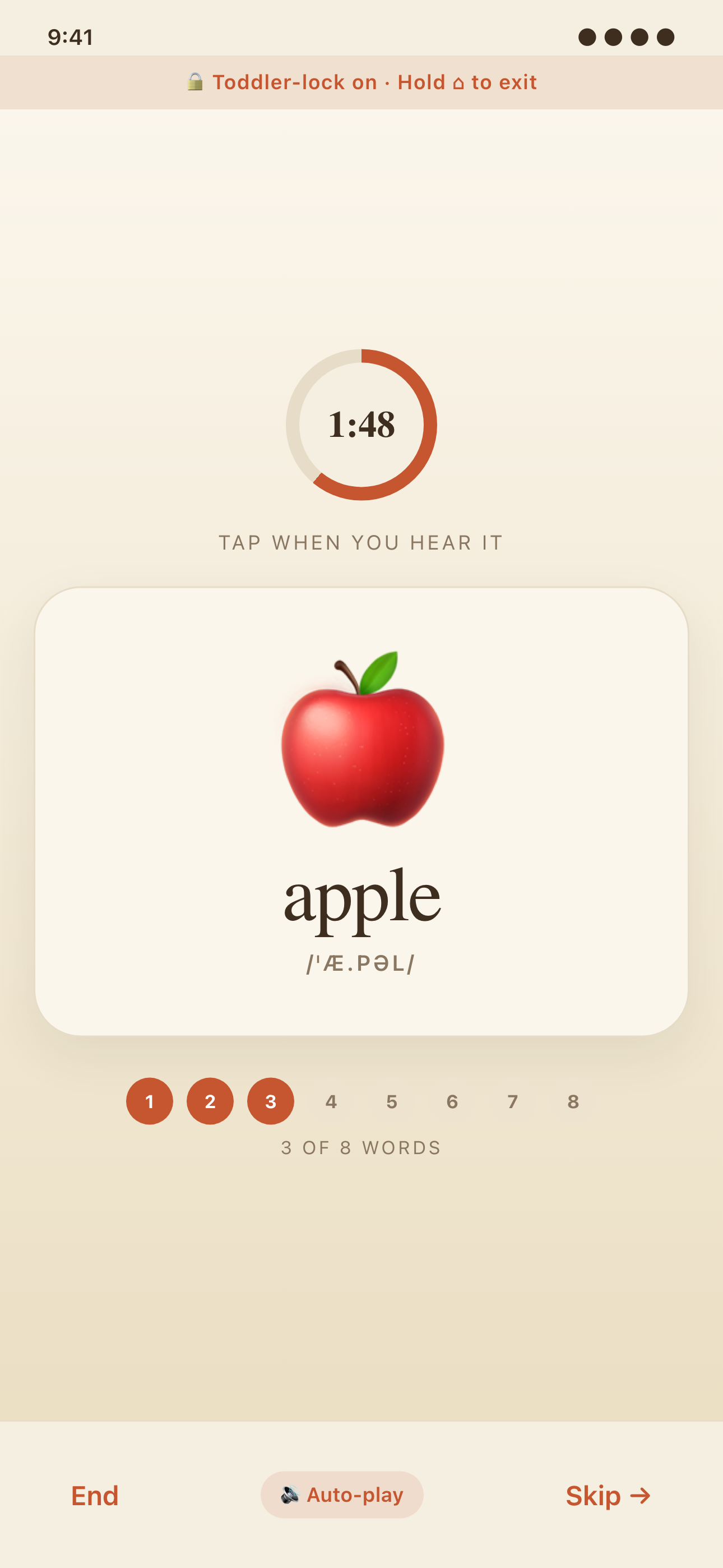
every card pairs a clear picture, the written word, and slow-able spoken audio (text-to-speech), so your 1–3 year old hears and says each word. Tap to mark the ones they got; Skip moves on.
Slow speech down so toddlers can copy it
adjust the spoken audio to 0.5×, 0.75×, 0.85×, or 1.0×, toggle auto-play voice, and show optional phonetic pronunciation: a genuine aid for early talkers and late talkers alike.
Stop the screen-time spiral before it starts
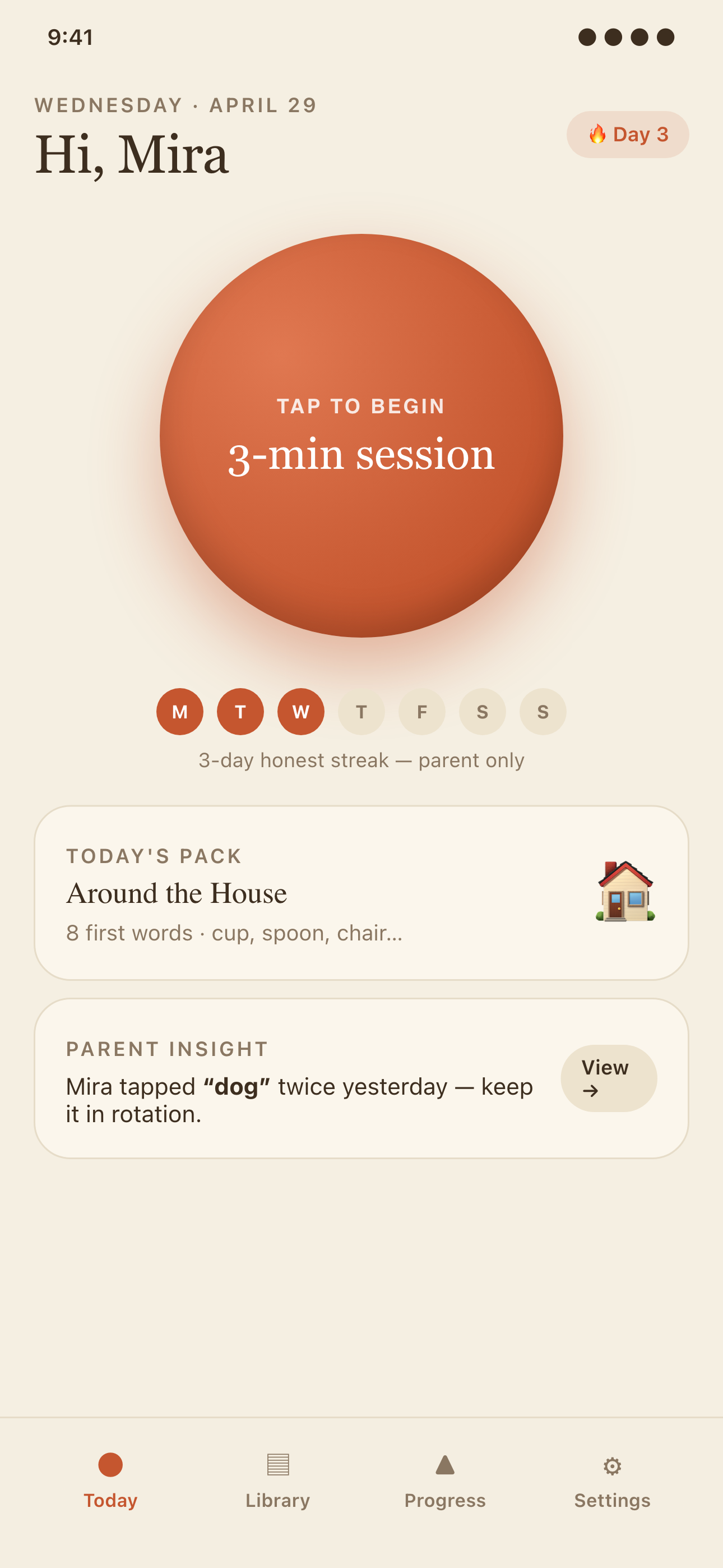
each session is a gentle ~3-minute ritual (set it 2–5 min) of 6–12 words that softly auto-stops. No autoplay, no rabbit hole: Acorn nudges you both to put the phone down.
Trust the app with your toddler
a child-safe toddler-lock keeps little fingers inside the session (hold-to-exit), while a 4-digit parent passcode: stored in the device keychain with a lockout and a Forgot-passcode reset: guards every settings and purchase screen.
Grow with real words your child knows
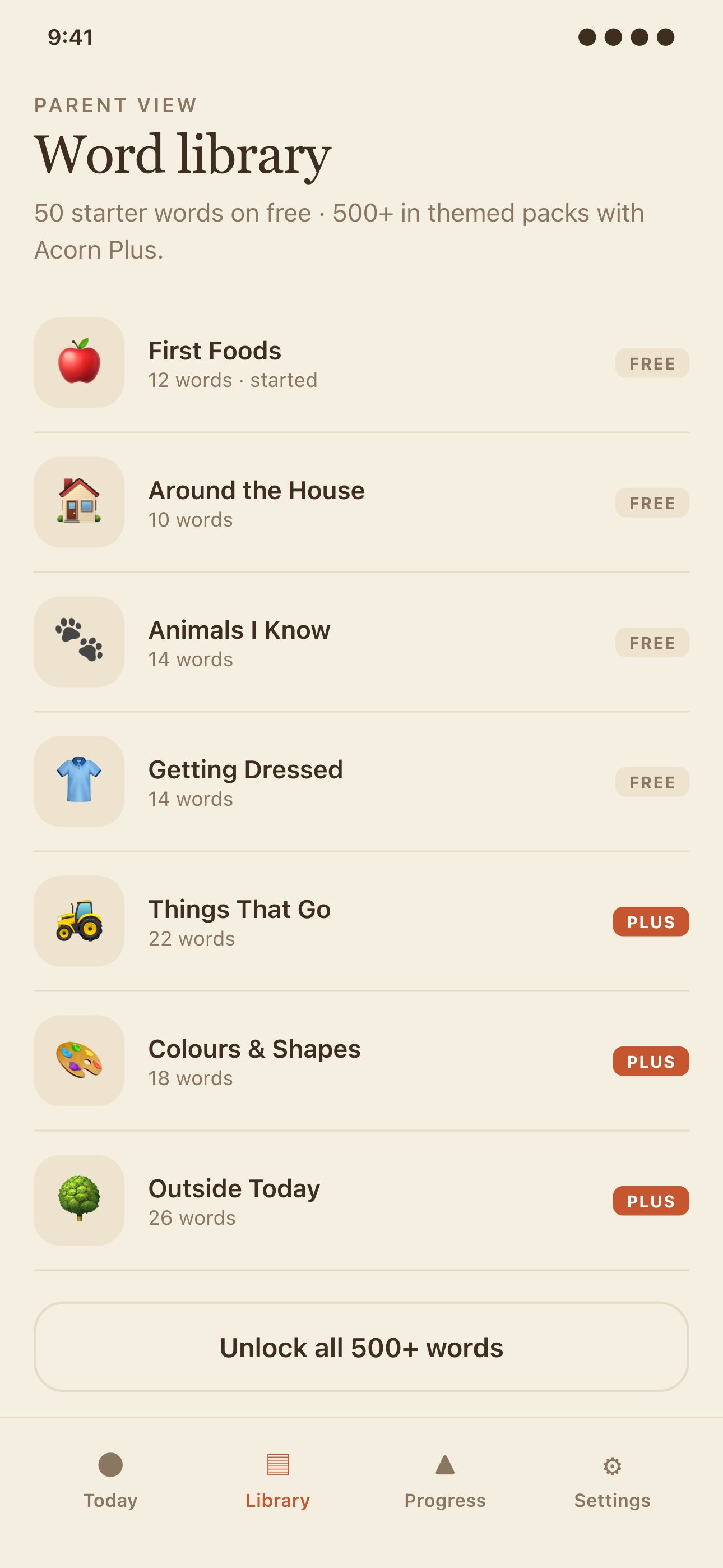
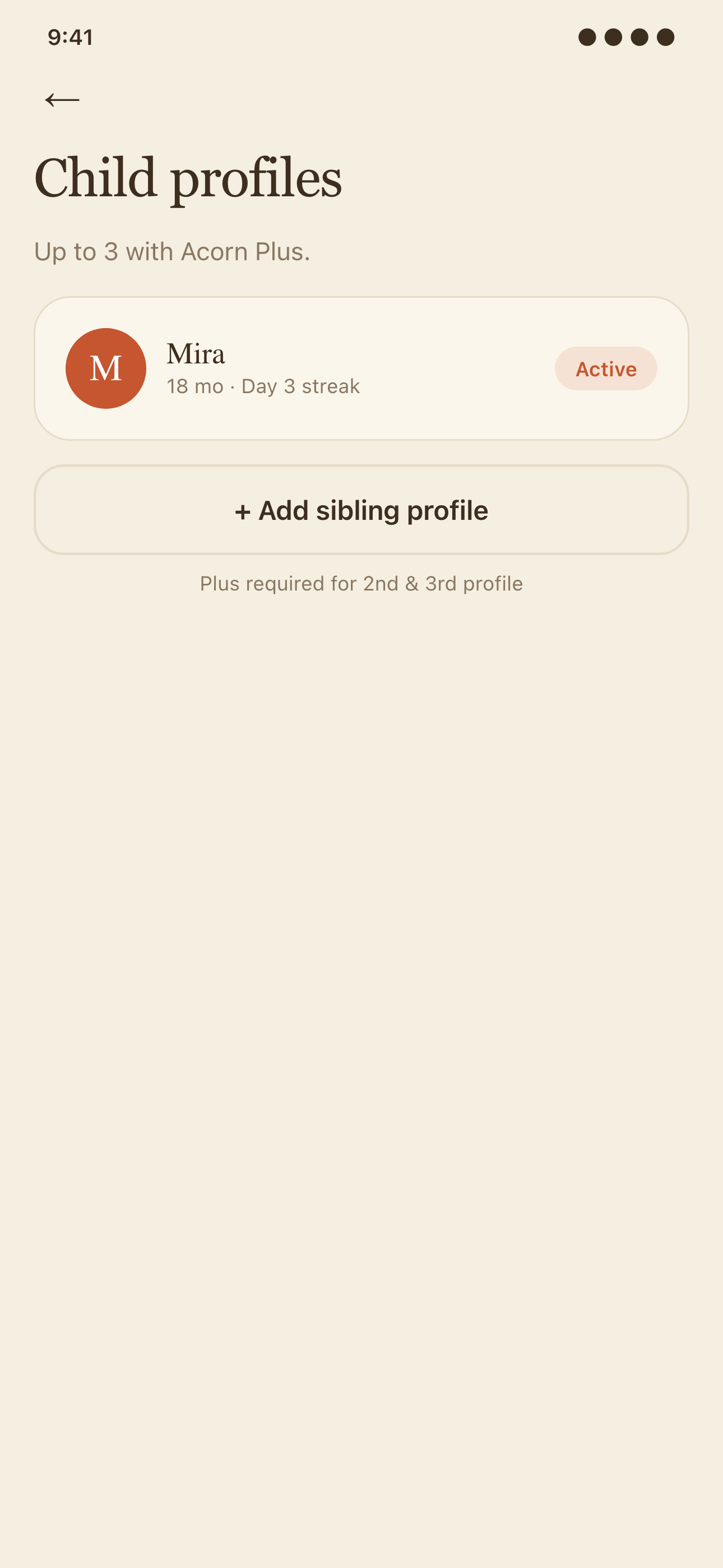
9 themed word packs (~144 words) starting with 4 free packs: First Foods, Around the House, Animals I Know, Getting Dressed: and 5 Acorn Plus packs covering Things That Go, Colours & Shapes, Outside Today, My Body, and Action Words.
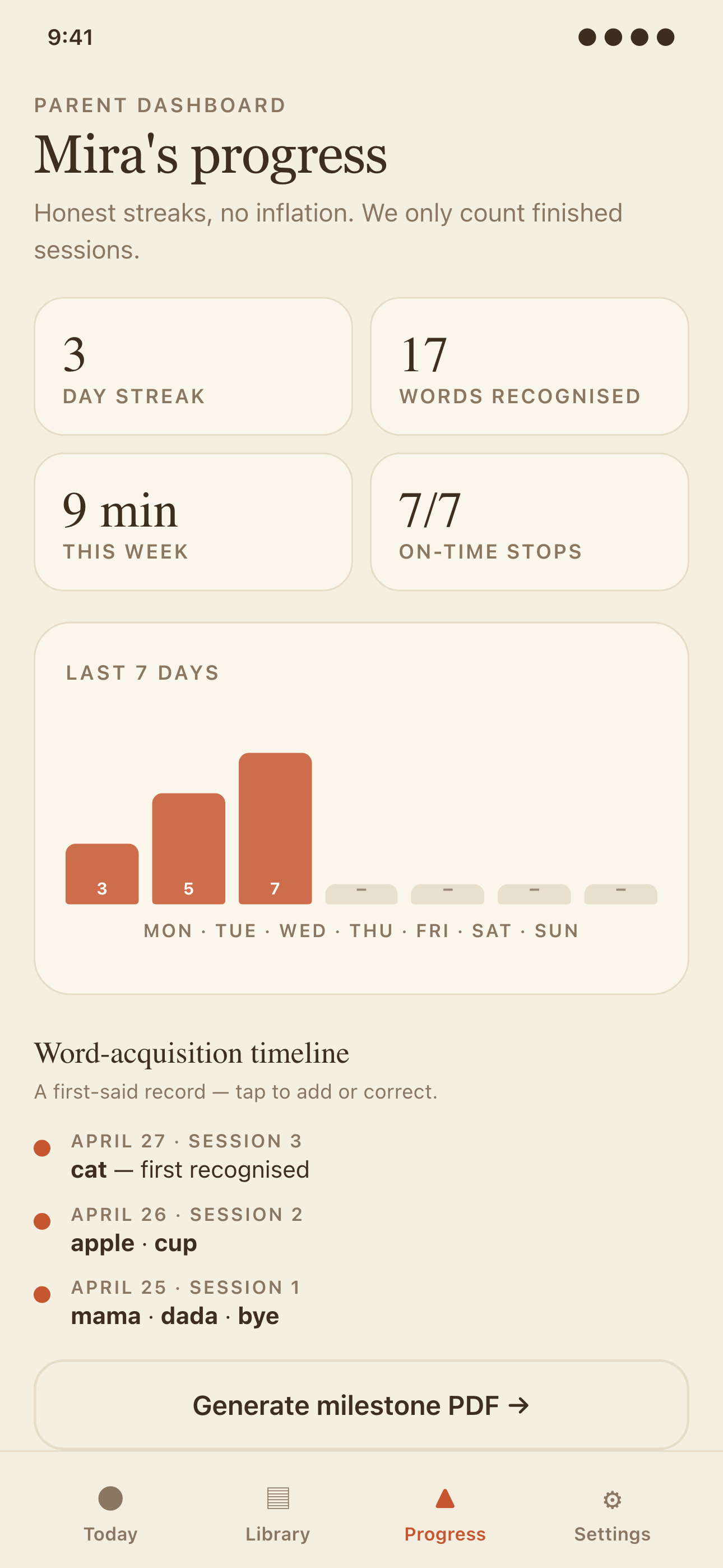
See honest progress, not vanity streaks
track each child's word events and session history with a streak that only counts sessions you finish. Add sibling profiles, and export a milestone PDF on Acorn Plus.
Private by design
everything lives on the device with no account required, no ads, and no microphone or camera access. Optional analytics and crash reporting stay off unless you turn them on, and an optional Sign in with Apple is parent-only.
Fits your routine
one optional daily reminder for the parent (a quiet local notification, no push servers), and Acorn Plus members can raise the limit to 2 sessions a day.
A look inside
See it in your hands.
How it works
Up and running in under two minutes.
- 01
- 02
- 03
A note from the studio
“I kept reaching for a toddler app and finding the same thing: ads, characters engineered to hold attention, and a paywall my kid could somehow tap through. I wanted the opposite — a few quiet minutes of real first words, nothing harvesting data in the background, and a clear stopping point. So we built Acorn to do one small thing well, and then to gently suggest you both put the phone down.”
Questions
The honest answers.
Is Acorn free, and what does the subscription cost?
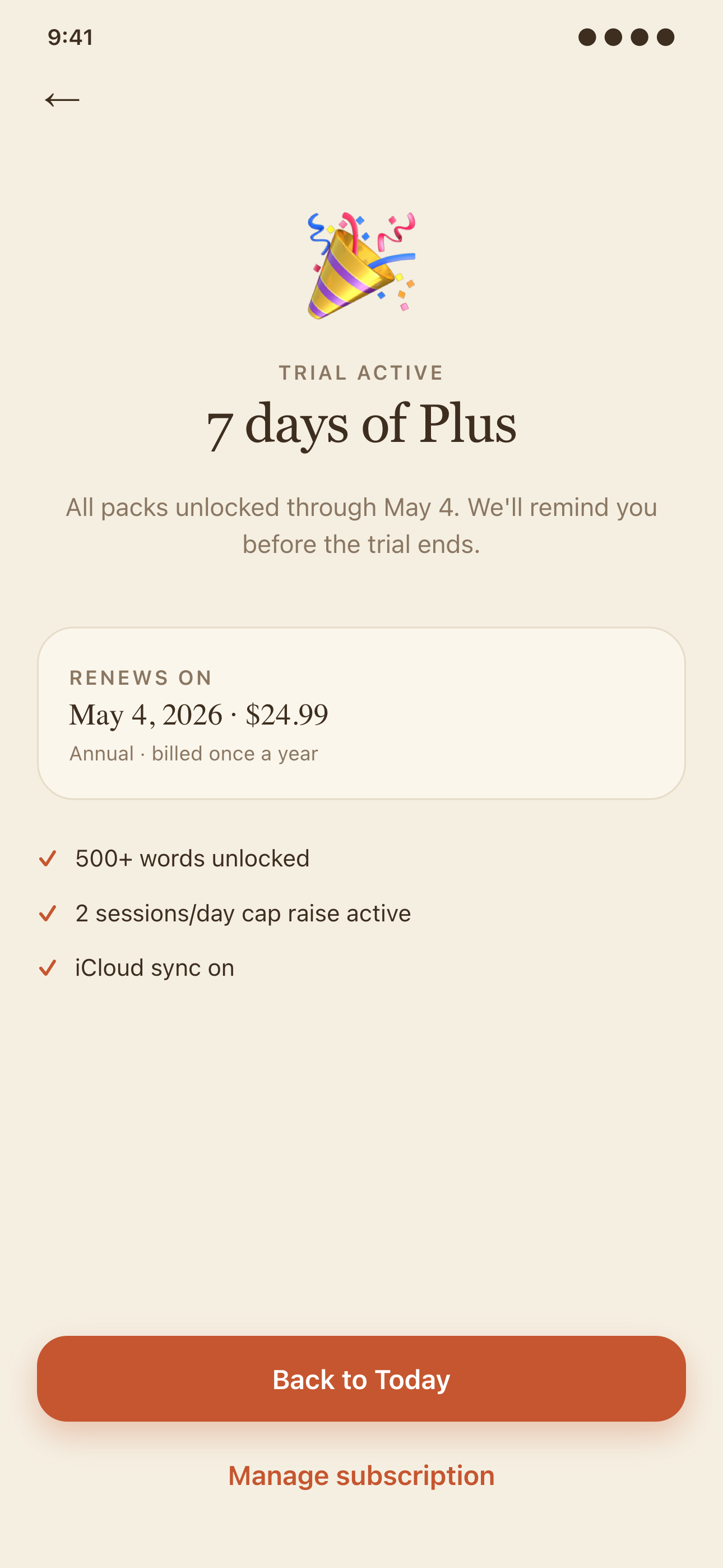
Acorn is free to start: 4 starter word packs (50 words) and one 3-minute session a day, with no account. Acorn Plus unlocks the full library, sibling progress export, and a second daily session for $1.99/month, or $14.99/year (about $1.25/month) with a 7-day free trial.
Do you collect any data about my child?
No. Acorn runs entirely on-device — your child's profile and word history never leave the phone. There's no microphone listening, no camera, and no advertising IDs. The only optional analytics and crash reporting are parent-controlled and off by default.
Are there ads or in-app purchases my toddler could tap?
None. There are no ads anywhere, and the only purchase screen sits behind a 4-digit parent passcode your toddler can't pass. A toddler-lock also keeps them inside the session so little fingers can't wander off.
Does Acorn work offline?
Yes. Word cards, pictures, and spoken audio all run on the device, so sessions work fully offline — on a plane, in the car, or anywhere without Wi‑Fi.
How is Acorn different from Speech Blubs, Lingokids, or YouTube?
Acorn is a short, bounded ritual, not endless entertainment. Sessions are parent-led first-words practice that auto-stop after about 3 minutes — no autoplay, no characters hooking attention, no ad loops. It's built to be calm and trustworthy, then put down.
What ages is Acorn for, and is it a speech-therapy tool?
Acorn is designed for toddlers roughly 1–3 years old, used alongside a parent. It's an early-learning toy to support first words and early talkers — not a speech-therapy program or a developmental assessment. The slow-able audio simply makes words easier to hear and copy.
What platforms is Acorn on?
Acorn is available on the iOS App Store for iPhone and iPad. Everything stays on your device; there's no account to create, and an optional, parent-only Sign in with Apple is supported.
What if I forget the parent passcode?
You can reset it with the Forgot-passcode option on the parent gate. The 4-digit passcode is stored securely in the device keychain and protected by a short lockout after several wrong tries.
Launching soon
Be first to know when Acorn ships.
It'll launch at $1.99/mo. Free tier: 4 free starter packs (50 words), 1 session/day, on-device, no account.
One email when it lands on the store. No drip sequence, no spam.
No spam. No tracking. Email only — unsubscribe with one click.
Acorn stores everything — your child's profile, words tapped, session history, settings, and the parent passcode — locally on the device. There is no account requirement and no Lumen Labs backend.
From the journal
Notes on the practice.
- 01
Should You Correct Your Toddler's Speech? The Science of the Recast
Should I correct my toddler's speech? A famous experiment says no: they already hear the word correctly. What works instead is the recast — here's how to do it.
2026-07-13
6 min read
- 02
Does Baby Sign Language Delay Speech? What the Research Really Found
Does baby sign language delay speech? No — and it won't raise IQ either. What signing actually does for toddlers, and the one ingredient that truly matters.
2026-07-13
7 min read
- 03
Why Is My Toddler Suddenly Stuttering? The Science of Normal Disfluency
A toddler suddenly stuttering is usually a sign language is surging, not breaking. The science of normal disfluency, what actually helps, and when to check further.
2026-07-12
6 min read
- 04
Do Boys Really Talk Later Than Girls? The Truth About the Gender Gap in First Words
Do boys talk later than girls? The gap is real but tiny — and the 'boys talk late' excuse can delay help for the kids who need it most. What large studies show.
2026-07-12
6 min read
- 05
Why Does My Toddler Say 'You' Instead of 'Me'? The Science of Pronoun Reversal
Toddler pronoun reversal — saying 'you' when they mean 'me' — isn't confusion. It's proof your child is solving the hardest word problem in English.
2026-07-11
6 min read
- 06
Why Does My Toddler Ask 'What's That?' All the Time? The Science of the Question Phase
Why does my toddler ask what's that all day? Because they're running the best vocabulary program ever designed — and how you answer decides what sticks.
2026-07-11
6 min read
- 07
Why Does My Toddler Take So Long to Respond When I Say a Word? The Science of Processing Speed
Why does my toddler take so long to respond when I say a word? Because recognizing a word takes time — and how fast they do it quietly predicts how many words they'll have.
2026-07-10
7 min read
- 08
When Do Toddlers Learn Emotion Words? Why 'Sad' Is Harder Than 'Spoon'
Wondering when toddlers learn emotion words? The answer is later than you'd think — because feelings can't be pointed at. Here's how children learn to name what's inside.
2026-07-10
7 min read
- 09
Why Did My Toddler Stop Saying a Word They Used to Say? The Science of Disappearing Words
If your toddler stopped saying words they used to say, you're watching normal reorganization, not loss. What disappearing words mean — and the one pattern worth a doctor's call.
2026-07-09
7 min read
- 10
Does Background Talk Help Toddlers Learn Words? The Science of Overheard Speech
Does background talk help toddlers learn words? All-day recordings say no. Here's the real difference between speech that happens near your child and speech aimed at them.
2026-07-09
7 min read
- 11
Why Do Babies Say 'Mama' and 'Dada' First? The Science of Reduplicated Babbling
Why do babies say mama and dada first? It isn't that they've named you. The real answer is hidden in the mechanics of a baby's mouth — and it's stranger and sweeter than you'd think.
2026-07-08
6 min read
- 12
Why Can't My Toddler Tell Me About Their Day? The Science of the Here-and-Now
Wondering why your toddler can't talk about the past? The science of displaced language explains why little ones live in the here-and-now — and how reminiscing gently pulls them out of it.
2026-07-08
6 min read
- 13
Why Does My Toddler Sort Things by Shape? The Science of the Shape Bias
The shape bias is why toddlers extend a new word to same-shaped objects. Learn how this quiet rule of first words works — and how to help it grow.
2026-07-07
6 min read
- 14
Why Does My Toddler Point and Say a Word at the Same Time? The Gesture That Predicts Sentences
Why does my toddler point and say a word at the same time? That pairing of gesture and speech is the quiet rehearsal for their first two-word sentences — here's the science.
2026-07-07
6 min read
- 15
How Do Babies Learn Where One Word Ends and the Next Begins?
How do babies learn where words begin and end when speech has no gaps? The science of speech segmentation, statistical learning, and why your name is your baby's first anchor.
2026-07-07
6 min read
- 16
Why Does My Toddler Say a Word in One Place but Not Another? The Science of Context-Bound Words
If your toddler says "duck" in the bath but never for a real duck, you've met context-bound words. Here's why toddlers only say a word in one place — and how to help it travel.
2026-07-06
6 min read
- 17
Why Does My Toddler Point at Everything? The Gesture That Comes Before First Words
Why does my toddler point at everything? Because pointing is the first word before words. The science of how the index finger predicts your child's vocabulary.
2026-07-06
7 min read
- 18
Why Does My Toddler Talk Gibberish? The Science of Jargon Babbling
Why does my toddler talk gibberish that sounds like real sentences? Inside jargon babbling — the melody-first stage where conversation arrives before words.
2026-07-05
7 min read
- 19
Why Does My Toddler Repeat Everything I Say? The Science of the Echo Stage
If your toddler repeats everything you say, that echo isn't empty mimicry — it's one of the oldest engines of language learning. Here's how it works, and how to answer it well.
2026-07-04
6 min read
- 20
How to Read to a Toddler: The Science of Dialogic Reading
Dialogic reading with toddlers turns story time into conversation. The research-backed way to read a picture book so first words actually stick — starting tonight.
2026-07-04
7 min read
- 21
Do Second Children Talk Later? What Birth Order Really Does to First Words
Do second children talk later than firstborns? What birth-order research actually shows about siblings, overheard words, and the quiet advantages of being born second.
2026-07-04
7 min read
- 22
Why Your Toddler Talks to Themselves in the Crib: The Quiet Science of Crib Speech
Heard your toddler talking to themselves in the crib after lights-out? That solo chatter is called crib speech — and it may be the hardest language work they do all day.
2026-07-03
7 min read
- 23
When Do Toddlers Learn Colors? Why 'Blue' Comes So Long After 'Ball'
When do toddlers learn colors, and why does 'blue' lag so far behind 'ball'? The real science of color words — and the small change in wording that helps.
2026-07-03
6 min read
- 24
Do Bilingual Toddlers Talk Later? What the Science Says About Growing Up With Two Languages
Do bilingual toddlers talk later? No — the milestones hold. What research says about mixed sentences, split vocabularies, and how two languages actually grow.
2026-07-02
6 min read
- 25
How Do Toddlers Know What a New Word Means? The Quiet Logic of One Name Per Thing
How do toddlers figure out what a new word means? Meet mutual exclusivity — the hidden rule that lets a one-year-old guess the right object without being told.
2026-06-27
7 min read
- 26
Do Toddlers Learn Words in Their Sleep? The Science of Naps and First Words
Do toddlers learn words in their sleep? Naps don't just rest a tired toddler — they consolidate new words into lasting memory. Here's the science of sleep and language.
2026-06-27
7 min read
- 27
Why Your Toddler Understands More Than They Can Say: The Comprehension Gap
If your toddler understands more than they can say, that's normal. Here's the science of the comprehension gap in first words—and how to gently close it.
2026-06-26
7 min read
- 28
Why Nursery Rhymes Help Toddlers Learn to Talk: The Science of Song and First Words
Do nursery rhymes help toddlers talk? Yes—and not for the reason you'd guess. How melody, rhythm, and the pause before "star" quietly build first words.
2026-06-26
7 min read
- 29
Why Does My Toddler Mispronounce Words? The Hidden Logic Behind "Wawa" and "Pasghetti"
Why does my toddler mispronounce words like "wawa" and "pasghetti"? The science of phonological processes shows toddler speech errors follow strict, predictable rules.
2026-06-26
6 min read
- 30
Why Your Toddler Wants the Same Book Over and Over (And Why You Should Let Them)
Why toddlers want the same book over and over isn't a rut — it's how they learn words. The science of repeated reading, and why sameness builds vocabulary.
2026-06-24
6 min read
- 31
Why Toddlers Learn Words Best With Something in Their Hands
How toddlers learn words through play comes down to one thing: what's in their hands. The science of hands, eyes, and first words — and how to use it at home.
2026-06-23
6 min read
- 32
Why Toddlers Learn Nouns Before Verbs: The Science of First Words
Why do toddlers learn nouns first? The science of the noun bias—why 'ball' and 'dog' come before 'give' and 'run,' and how to gently help verbs catch up.
2026-06-23
7 min read
- 33
Why Does My Toddler Call Every Animal a Dog? The Science of Overextension
Why does my toddler call every animal a dog? Overextension is a sign of category-building, not a mistake — here's the science of what's really happening, and how to respond.
2026-06-23
7 min read
- 34
What to Say When Your Toddler Says One Word: The Quiet Power of Expansion
How to respond when your toddler says one word: a simple research-backed technique called expansion that turns 'ball' into a whole sentence and grows vocabulary fast.
2026-06-22
7 min read
- 35
How Many Times Does a Toddler Need to Hear a Word? The Science of Spaced Repetition
How many times does a toddler need to hear a word before it sticks? The answer isn't a number — it's a rhythm. The science of spaced repetition and first words.
2026-06-22
7 min read
- 36
Conversational Turns and Toddler Language: Why the Pause Matters More Than the Word Count
Conversational turns shape toddler language development more than sheer word count. Here's why the pause after you speak does the heavy lifting — and how to use it.
2026-06-21
6 min read
- 37
Is Baby Talk Bad for Toddlers? The Science of Parentese and First Words
Is baby talk bad for toddlers? Not the sing-song kind. Learn how parentese — slow, high-pitched, real-word speech — helps your toddler learn to talk.
2026-06-18
7 min read
- 38
The Three-Minute Rule: Why Consistency Beats Duration
Building a toddler daily learning routine: why three consistent minutes beat a long weekly session, and how tiny rituals make first words actually stick.
2026-06-11
5 min read
- 39
Joint Attention and Toddler Talk: Why Words Stick When You Both Look at the Same Thing
Joint attention is the quiet engine behind toddler language. Learn why naming what your child is already looking at teaches more words than pointing things out.
2026-06-11
7 min read
- 40
Word Apps vs Flashcards vs Books for a Toddler's Vocabulary
Toddler flashcards vs books vs word apps: an honest comparison of what each method actually does for early vocabulary, and how to choose between them.
2026-06-08
5 min read
- 41
Screen Time Before Two: How to Use a Screen Without the Guilt
Screen time for a toddler under 2, explained without judgment: what the AAP guidance really says, why co-viewing matters, and how to use a screen well.
2026-06-04
5 min read
- 42
When Do Toddlers Start Talking? A Calm Guide to First Words
When do toddlers start talking? A reassuring beginner's guide to first-word milestones, the normal range, and the signs that actually matter before age three.
2026-05-31
5 min read
- 43
Why Most Toddler Learning Apps Don't Actually Stick
Why toddler learning apps fail: engagement traps, overstimulation, and the design choices that exhaust a child's attention instead of building it.
2026-05-26
5 min read
- 44
How Toddlers Learn Words: Fast Mapping and the Vocabulary Spurt
How toddlers learn vocabulary, explained: fast mapping, the word spurt, and the hidden mental rules a one-year-old uses to attach meaning to sound.
2026-05-20
5 min read
- 45
Do 'Educational' Baby Apps Actually Make Toddlers Smarter?
Do toddler learning apps work? An honest look at the science behind 'educational' baby apps, the video deficit, and what a screen can and cannot teach a one-year-old.
2026-05-14
5 min read
- 46
How to Teach Your Toddler Their First Words at Home
A calm, practical guide to teaching toddler first words at home — using everyday objects, slow speech, and shared attention, without flashcards or pressure.
2026-05-08
5 min read